Movie
A Life Illuminated
No tropes matched for this movie.
Full plot (spoilers)
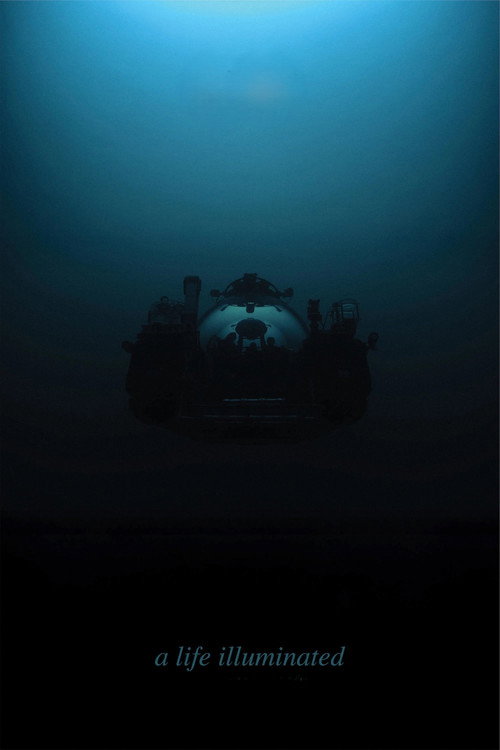
A Life Illuminated is a 2025 documentary directed by Tasha Van Zandt that chronicles the five-decade career of pioneering marine biologist Dr. Edith "Edie" Widder and her lifelong obsession with bioluminescence in the deep ocean. The film opens with Widder's unexpected origin story: as an undergraduate, she temporarily lost her vision following surgery, an experience that ignited a profound fascination with light and its role in life. This personal turning point set her on a path into the darkness of the deep sea. The documentary traces her early career in the 1980s, when she conducted pioneering submersible dives in equipment originally designed for offshore oil work—not scientific research—pushing the frontier of what was known about light-producing organisms in the deep ocean. During this period she survived a life-threatening flooding incident inside a submersible, yet returned to the sea almost immediately to continue her research. Over the decades, Widder developed breakthrough research tools including the SPLAT screen and the Eye-in-the-Sea camera system, purpose-built to observe bioluminescent creatures without disturbing them with artificial light. A landmark moment highlighted in the film is her instrumental role in capturing the first-ever video footage of a giant squid in its natural deep-sea habitat, filmed in 2012 off Japan's Ogasawara Islands. The film also weaves in the institutional and social challenges Widder faced as a female scientist across her career, and her founding of the Ocean Research and Conservation Association. The documentary's central narrative concerns a 2023 expedition to the Azores aboard the OceanX vessel, where Widder and her team attempt to film "flashback"—a rare phenomenon in which multiple deep-sea organisms simultaneously light up in cascading response to an external light source. The film contextualizes bioluminescence's evolutionary functions—predator avoidance, prey attraction, communication—and presents Widder's hypothesis that flashback is triggered by luminescent bacteria traveling on marine snow drifting through the water column. The documentary builds steadily toward the climactic expedition footage; as one review noted, after learning how precious even a single clear shot of bioluminescent activity is, viewers are ultimately rewarded with what the film calls "the whole fireworks display"—high-quality footage of flashback successfully captured by Widder's team.
Sources: Wikipedia, Mongabay, Web search (Deadline, IndieWire, Sandbox Films, TIFF, Letterboxd)