Movie
James McNeill Whistler
No tropes matched for this movie.
Full plot (spoilers)
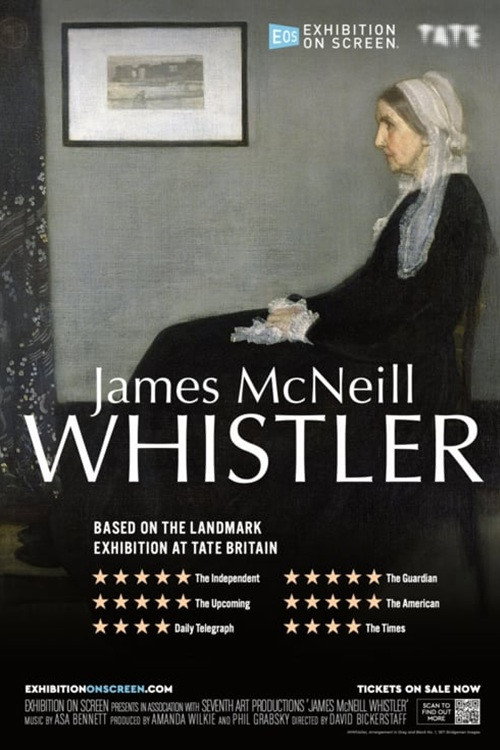
James McNeill Whistler (2026) is a 90-minute documentary produced by Phil Grabsky and directed by David Bickerstaff for the Exhibition on Screen series, created in close collaboration with Tate Britain to accompany its first major Whistler retrospective in three decades (on view until 27 September 2026). The film brings the exhibition to cinema audiences worldwide, using exclusive access to the gallery spaces to guide viewers through the life and work of the American-born painter who spent much of his career in London and Paris.
The documentary traces Whistler's evolution from a provocative outsider to one of the most influential artists of the 19th and early 20th centuries. It examines his foundational philosophical stance — that a painting need not tell a story or preach a moral lesson, that beauty alone is sufficient justification — giving rise to the "art for art's sake" movement. This is illustrated through his unconventional titling practice: calling paintings "arrangements," "harmonies," and "nocturnes" to foreground their musical, tonal qualities rather than their subjects.
The film gives sustained attention to his most iconic work, Arrangement in Grey and Black No. 1 (popularly known as Whistler's Mother), situating it within his broader series of tonal portraits and his innovative approach to mark-making, atmosphere, and color harmony. His celebrated Nocturne series — dreamlike, near-abstract views of the Thames at night — receives extended analysis as an expression of his radical formal language.
The documentary also charts the controversies that defined Whistler's public persona. His bitter dispute with industrialist Frederick Leyland over the decoration of the Peacock Room is explored as a clash between artistic autonomy and patronage. More prominently, the film covers his famous libel suit against critic John Ruskin, who had savaged one of Whistler's Nocturnes; the trial became a landmark moment in the history of artistic freedom. His contentious relationship with fellow artist Dante Gabriel Rossetti and his place within the wider circle of Victorian artist-friends, models, and patrons also feature. Tate curator Dr. Carol Jacobi and several art historians provide commentary throughout, placing Whistler within the artistic and social world of his era and arguing for his lasting influence on modernism.
Sources: Exhibition on Screen / Tate Britain promotional materials, LondonTheatre1 review, Seenit article, Love London Love Culture news item, Ikon London Magazine article, Frostmagazine.com press item, TMDb overview