Movie
On Falling
Cultural messages
Be Yourself
highAurora consistently suppresses her authentic self — lying about hobbies (travel, karaoke) she cannot afford, masking financial precarity in social interactions. External pressure to project a 'normal' life is present throughout. The film's resolution is explicitly a breakdown of that suppression: the job interview scene where her distress surfaces unguarded is framed as a metaphorical 'falling' that opens the possibility of reconnecting with her own identity. Signals hit: she pretends to be normal (hides circumstances, fabricates hobbies); conformity is depicted as painful and stifling (the entire arc of accumulated small indignities); a transformation/reveal scene marks the moment (job interview); and authentic expression is framed as the path back to selfhood.
About this message: A character hides or suppresses their true identity to conform, then finds strength and happiness by embracing who they really are. Authenticity is the real superpower.
Movies that share these tropes






Full plot (spoilers)
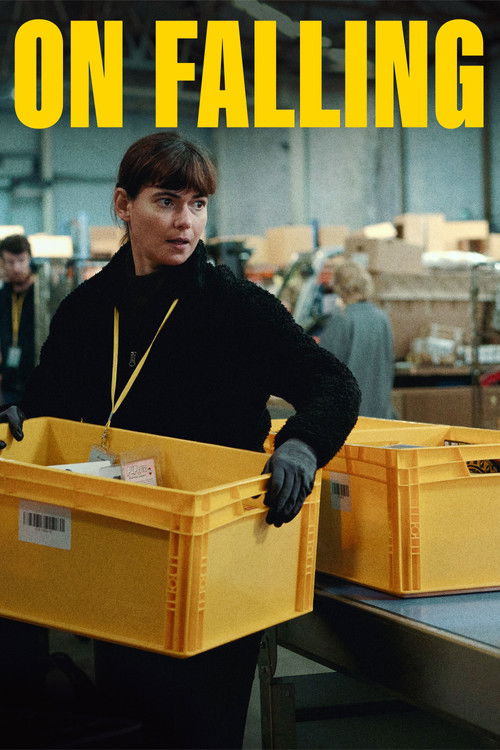
On Falling follows Aurora, a young Portuguese woman living in Edinburgh, Scotland, who works as a picker in a vast Amazon-style warehouse fulfilment centre. The film spans roughly one week, observing her daily rhythms: commutes, long shifts under sickly fluorescent lighting that erases any sense of day or night, and evenings spent in solitary flatshare rooms. Aurora is managed by algorithm — her handheld scanner beeps if she takes too long between picks, and supervisors know her by ID number rather than name, rewarding exceptional performance with nothing more than chocolate. An early, passing mention of a co-worker's unexplained death briefly tilts the film toward psychological thriller territory, but the story deliberately refuses that pivot, remaining resolutely in the register of accumulating small indignity. Aurora longs for connection yet consistently retreats from it, distracted by her phone during moments when colleagues reach out. She and a friend talk wistfully about office jobs with regular hours and stable salaries. Financial precarity is rendered in fine-grained detail: she borrows shampoo when she cannot afford her own, and lies politely about hobbies like travel and karaoke because those pleasures are effectively closed off to her. A recurring visual motif — a cardboard box tumbling backward on an upward conveyor belt, making no progress — encapsulates her Sisyphean position. The film is not without warmth: small acts of kindness from co-workers punctuate the alienation. The emotional arc resolves not through escape but through a moment of unguarded honesty during a job interview, where Aurora's suppressed distress finally breaks the surface — a metaphorical 'falling' that paradoxically represents the possibility of reconnecting with her own identity.
Sources: Wikipedia, BFI Sight & Sound review, Loud and Clear Reviews