Movie
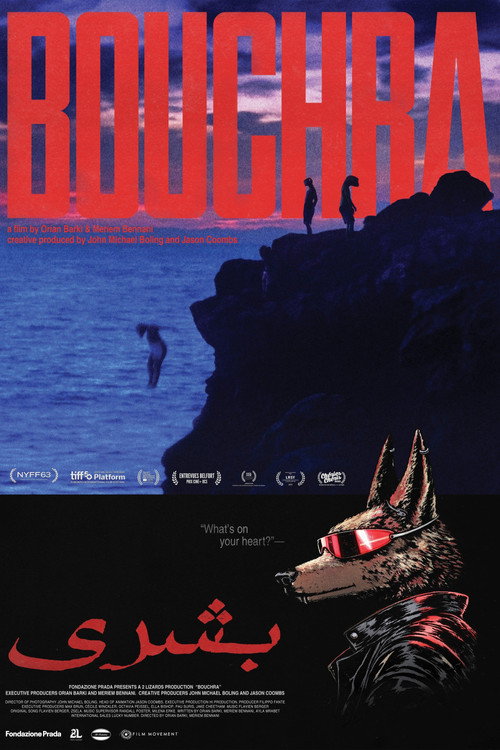
Bouchra
Narrative tropes
A Parent's Shadow
mediumBouchra's arc is wholly defined in relation to her mother: both appear in parallel 'real' and 'fictional' versions, and the film's metafictional structure foregrounds how thoroughly Aicha shapes Bouchra's identity. Inherited cultural expectations — being a queer Moroccan woman whose family has not fully processed her coming-out — drive the central conflict. The resolution has her defining herself on her own terms at the family dinner, and the story explicitly frames this as forging her own path rather than remaining silent within her Moroccan family legacy.
About this trope: A character must grapple with the legacy of their parents or predecessors — living up to high standards, running from expectations, atoning for inherited sins, or forging their own path.
Cultural messages
Be Yourself
highBouchra suppressed her queer identity for nine years after an unresolved coming-out letter; the writer's block on her semi-autobiographical film literalizes the stifling cost of that suppression. The family dinner in Casablanca where she speaks openly about her film is the transformation/reveal scene. Her aunt's warm 'I am with my best family' marks social acceptance following self-acceptance. Crucially, the creative breakthrough flows directly from authenticity — the honest calls with her mother become the raw material for the film, making self-acceptance the literal source of artistic power.
About this message: A character hides or suppresses their true identity to conform, then finds strength and happiness by embracing who they really are. Authenticity is the real superpower.
Family Is Everything
mediumThe mother-daughter relationship with Aicha is the story's central spine, and a nine-year emotional estrangement (the unresolved coming-out) is the operative 'threat to family.' The Casablanca family dinner functions as the emotional climax — a reunion scene — and the aunt's closing words ('I am with my best family') deliver the 'there's no place like home' sentiment explicitly. The film frames reconciliation with her mother and relatives as both the resolution of Bouchra's personal reckoning and the enabling condition for her artistic work.
About this message: Family bonds — biological or found — are ultimately what saves the day, provides meaning, and matters most. Characters who stray from family suffer; those who return are rewarded.
Movies that share these tropes




Full plot (spoilers)
Bouchra is a 35-year-old queer Moroccan canid (depicted as an anthropomorphic jackal) living and working as a filmmaker in Brooklyn. Stalled by writer's block on her first feature, she is developing a semi-autobiographical project set in Morocco whose fictional stand-in character has an affair with another woman while navigating family pressures. The creative blockage begins to crack when Bouchra resumes phone calls with her mother Aicha in Casablanca — conversations that are, in effect, a delayed continuation of a coming-out letter she sent her parents nine years earlier. Both Bouchra and Aicha exist simultaneously in 'real' and 'fictional' versions within the film, giving it a metafictional, collage-like texture expressed through text messages, video calls, visual and sonic puns, storyboarding sequences, and a play-within-a-film in which young animals dress up as vegetables. As the calls progress, Bouchra balances the economic precarity of being an artist in New York, a fractured cultural identity split between her Brooklyn life and her Casablanca upbringing, and an array of friendships and romantic entanglements. These difficult but overdue conversations gradually become the raw material feeding her film project. The story culminates at a family dinner in Casablanca where Bouchra at last speaks openly to her relatives about what her film is really about. Her aunt Yamna closes the scene with the words 'I am with my best family' — a phrase that also inspired the exhibition title behind the film's genesis. The film frames Bouchra's emotional reckoning with her mother and herself as the necessary path to artistic expression, weaving together themes of queer identity, diaspora, mother-daughter reconciliation, and the blurred line between autofiction and documentary.
Sources: Wikipedia, IMDb, Film Movement (distributor)