Movie
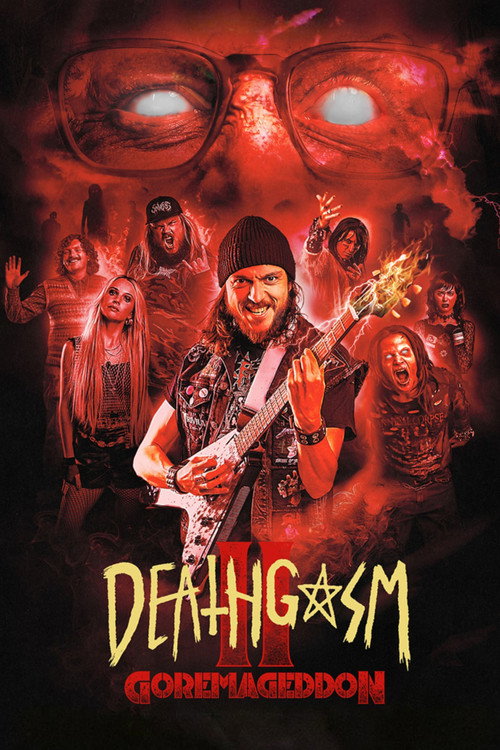
Deathgasm 2: Goremageddon
Narrative tropes
Man-Made Monsters
highBrodie (identifiable creator) uses dark necromantic magic to resurrect Zakk and Dion, a clear crossing of natural boundaries. The creations immediately exceed his control — both zombies behave destructively, one gains the autonomous power to raise additional dead, triggering a spreading zombie apocalypse. Hubris is explicit: the resurrection is motivated by a battle-of-the-bands competition and winning back an ex-girlfriend. Giles's containment efforts imply the warning that the creations are dangerous. Brodie's attempt to stop the carnage through heavy metal fails, and the dark force has the last word — the creator cannot master what he made.
About this trope: A creator uses science to overstep natural boundaries — creating life, resurrecting the dead, engineering organisms, or fundamentally altering nature — and the creation turns destructive.
Cultural messages
What Makes Us Human?
mediumThe two resurrected zombies develop divergent arcs that interrogate what humanity means: Zakk gradually renounces cannibalism and 'recovers his humanity' (a 'zomb-vegan'), while Dion rebels and retreats into a tabletop-gaming obsession. The story explicitly frames Zakk's arc as a recovery of humanity, blurring the line between undead instinct and genuine moral choice. The divergent paths of the two zombies — one moving toward humanity, one away — function as an implicit reflection on what makes a person human.
About this message: As the line between humans and non-humans blurs — AI, clones, aliens, robots — the story forces a reckoning with what truly defines humanity: biology, consciousness, memory, emotion, or moral choice.
Movies that share these tropes
Full plot (spoilers)
Set roughly a decade after the events of the original Deathgasm, Brodie is washed-up, broke, and aimless in small-town New Zealand. His bandmates are dead, Medina has left him for a successful music career alongside a pretentious new partner named Jesse Dead, and he has even lost his guitar to repossession. When Brodie learns of an upcoming battle-of-the-bands competition called NoizeQuest — which Medina will perform in — he sees it as his shot at both redemption and winning her back. The problem: his band is gone. His one surviving bandmate, Giles, is missing an arm. Brodie turns to dark necromantic magic, using old occult spells to resurrect his dead bandmates Zakk and Dion as undead zombies. The plan immediately goes sideways. Zakk and Dion return as ravenous, gut-munching zombies who pose a constant danger to the townspeople around them. Brodie and Giles spend much of the film trying to contain the situation — keeping their undead friends from consuming everyone they meet while still attempting to practice for NoizeQuest. As the story progresses, the two zombies develop in divergent directions: Zakk gradually renounces cannibalism and begins recovering his humanity, effectively becoming a 'zomb-vegan,' while Dion rebels against Giles's attempts to control him and retreats into a tabletop-gaming obsession. The chaos escalates when one of the resurrected bandmates gains the ability to raise additional dead, triggering a spreading mini zombie apocalypse across town. Brodie ultimately attempts to stop the carnage through the power of heavy metal, but the dark force known as the Black Hymn asserts itself and has the last word, leaving the film with a notably bleak ending. The film is a gore-heavy horror-comedy, described by the director as containing more blood and carnage in its first ten minutes than the entirety of the original film.
Sources: Eye for Film review, Dread Central review, Daily Dead review, TMDb overview, Web search aggregation