Movie
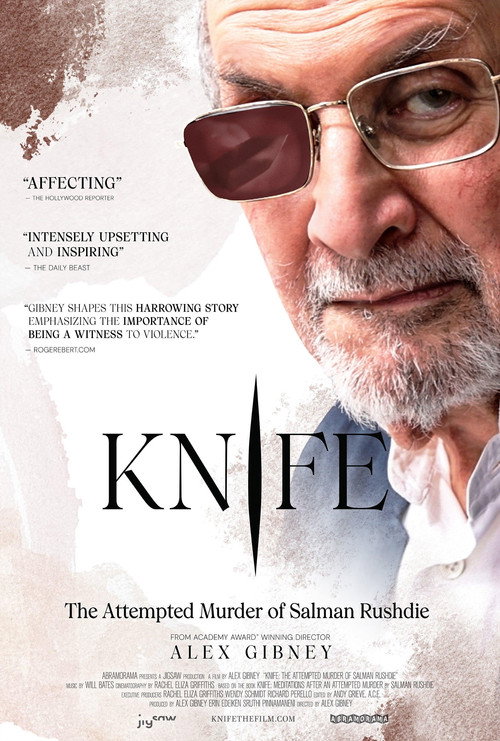
Knife: The Attempted Murder of Salman Rushdie
Narrative tropes
Humans Never Give Up
highRushdie survives 15 stab wounds and near-fatal injuries — objectively impossible odds — and the documentary's emotional arc is entirely his refusal to be destroyed by the attack. His darkly humorous, calm narration signals resilience rather than despair. The film concludes with his gradual return to writing and public life, framing survival itself as an act of resistance; the emotional climax is the decision to keep going, not a clear external 'victory' over his attackers. His wife's intimate footage of recovery reinforces that hope and spirit are restored against all rational expectation.
About this trope: Facing impossible odds, humans endure, adapt, and find reasons to keep going. Resilience and refusal to surrender is humanity's defining and most admirable trait.
Movies that share these tropes

Full plot (spoilers)
Knife: The Attempted Murder of Salman Rushdie is a 2026 documentary directed by Alex Gibney, adapted from Rushdie's memoir Knife: Meditations After an Attempted Murder. The film opens with the events of August 2022, when Rushdie—then 75 years old—was about to deliver a lecture at the Chautauqua Institution in upstate New York on the United States as a safe haven for writers in exile. Within seconds of taking the stage, a young Shia extremist named Hadi Matar rushed forward and stabbed Rushdie 15 times in roughly 27 seconds. Rushdie was airlifted to a hospital, where he barely survived, losing the sight in one eye and suffering nerve damage to his hand and other serious injuries. His wife, poet and photographer Rachel Eliza Griffiths, immediately began filming in the aftermath of the attack, providing intimate and unfiltered footage of his recovery in the days, weeks, and months that followed. Rushdie provides voiceover narration throughout the film, recounting his own near-death experience with a notably calm and darkly humorous voice. The documentary interweaves this personal recovery narrative with a broader historical account of how Rushdie came to be a target: his childhood under an abusive father, his emergence as a provocative literary intellectual, and above all the 1988 publication of The Satanic Verses, which was perceived by some Muslims as blasphemous and prompted Ayatollah Khomeini to issue a fatwa calling for his death in 1989. The film traces the ensuing decades of death threats and protective measures, leading up to the attack. Gibney also incorporates classic films that held personal significance for Rushdie, exploring how cinema sustained him during recovery and how the violence of the attack reshaped his experience of watching violent scenes on screen. Thematically, the documentary frames Rushdie's survival as an act of resistance against authoritarian forces seeking to silence free expression, and concludes with Rushdie's gradual return to writing and public life, his spirit and hope restored.
Sources: Wikipedia, The Wrap (review), IMDb (search metadata), TMDb overview, Deseret News, Deadline