Movie
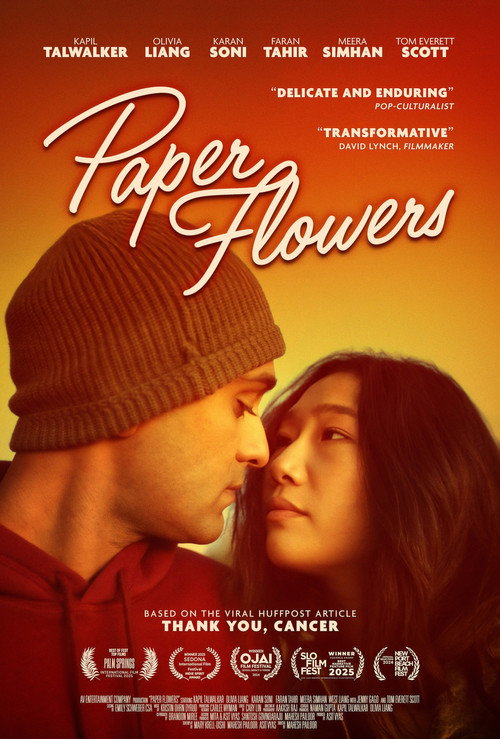
Paper Flowers
Narrative tropes
Humans Never Give Up
highShalin faces terminal synovial sarcoma — objectively hopeless — yet maintains 'striking positivity' through chemotherapy, counts 8,343 sunsets, writes 'Thank You, Cancer,' and inspires #SunsetsForShalin. The film's closing affirmation ('a life of purpose need not be measured in its length') frames this resilience as heroic. Hope persists when logic says it shouldn't; the emotional climax is the ongoing decision to keep living meaningfully, not a cure or survival.
About this trope: Facing impossible odds, humans endure, adapt, and find reasons to keep going. Resilience and refusal to surrender is humanity's defining and most admirable trait.
Cultural messages
Family Is Everything
mediumFamily relationships are structurally central: the parents' initial resistance to Fiona (a cultural/ethnic mismatch) creates a sustained subplot, and the illness becomes the catalyst that dissolves that resistance. The family facilitating a deathbed wedding is the emotional climax. Found family (Fiona's integration into the biological family) functions identically to blood kinship, and the resolution explicitly shows family bonds triumphing over prior division.
About this message: Family bonds — biological or found — are ultimately what saves the day, provides meaning, and matters most. Characters who stray from family suffer; those who return are rewarded.
Be Yourself
mediumTwo parallel arcs carry this trope: Shalin openly defies his traditional Indian-American family to pursue Peace Corps and his relationship with Fiona, with family conformity pressure depicted as real and stifling; and a secondary character's coming-out subplot, where a hidden identity is suppressed under social/family pressure before quiet resolution. Both arcs end in acceptance following self-assertion, and the family ultimately embraces who Shalin truly is.
About this message: A character hides or suppresses their true identity to conform, then finds strength and happiness by embracing who they really are. Authenticity is the real superpower.
Movies that share these tropes




Full plot (spoilers)
Paper Flowers dramatizes the true story of Shalin Shah, a 22-year-old USC graduate of Indian-American descent who, against the wishes of his traditional family and his Taiwanese-American girlfriend Fiona (based on real-life Frances Chen), departs to serve as a Peace Corps volunteer in rural Peru. Contemplative and idealistic, Shalin journals and meditates in the Peruvian countryside, feeling he is finally forging a life on his own terms. His plans are cut short when a persistent cough, breathing difficulties, and rib pain force him to seek medical attention; he is diagnosed with synovial sarcoma, a rare and aggressive cancer. He returns home to his Indian-American family—his father played by Faran Tahir and his mother by Meera Simhan—and reconnects with Fiona and his best friend Milan (Karan Soni), who provides moments of levity. Back home, tensions surface around the family's initial resistance to Fiona, whose cultural background differs from theirs, and a secondary thread involving another character's coming out as gay; both subplots are largely resolved quietly rather than through direct confrontation, with his parents ultimately embracing Fiona as Shalin's illness progresses. Shalin undergoes chemotherapy while maintaining a striking positivity, counting the 8,343 sunsets he estimates he has witnessed and encouraging those around him to pause and appreciate small beauties. Before his death, the family facilitates a wedding for Shalin and Fiona. Shalin channels his experience into the essay 'Thank You, Cancer,' published by HuffPost, which goes viral and resonates with readers worldwide. The film's title derives from a childhood memory: young Shalin crafted paper flowers after witnessing real flowers wilt, believing things should last forever—a symbol the older Shalin reexamines as he arrives at acceptance that 'death is part of life; you need both, and things can't last forever.' His reflections inspire the viral hashtag #SunsetsForShalin, through which thousands around the world share sunset photographs in his honor. The film closes on his enduring legacy—the essay, the hashtag, and the people whose perspectives he transformed—affirming that a life of purpose need not be measured in its length. Shalin Shah died in 2015 at a young age.
Sources: Film Threat review, DESIblitz feature, Stir/createastir.ca festival article, Write Drunk Edit Drunk review, paperflowersmovie.com official site, TMDb overview (provided), Web search results (Fandango, BroadwayWorld, Gay Desert Guide)