Movie
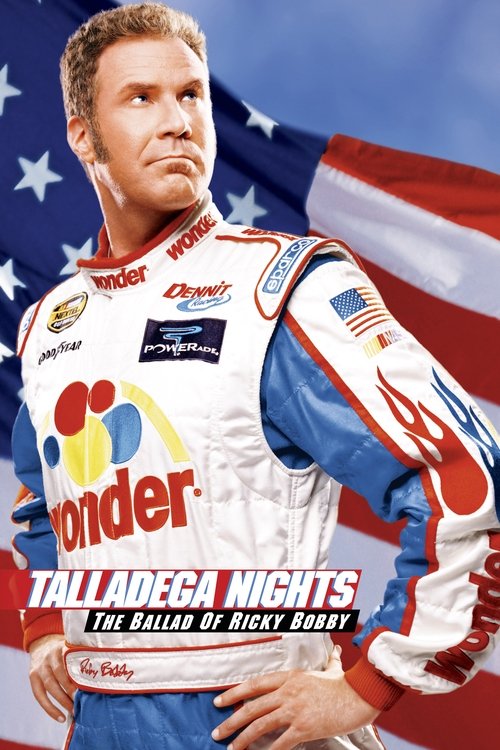
Talladega Nights: The Ballad of Ricky Bobby
Narrative tropes
A Parent's Shadow
highRicky's entire identity is constructed around his father's motto, 'If you ain't first, you're last,' imparted at age ten. The inherited creed shapes his racing philosophy, his marriage, his friendship with Cal, and his collapse when he can no longer live up to it. Reese's return forces Ricky to confront the legacy directly — and the revelation that the motto was drug-addled blather forces Ricky to define himself on his own terms. Signals: character explicitly compared to/shaped by parent, inherited creed creates the central conflict, must choose between legacy and own path, and resolution involves self-definition beyond that legacy.
About this trope: A character must grapple with the legacy of their parents or predecessors — living up to high standards, running from expectations, atoning for inherited sins, or forging their own path.
Cultural messages
Family Is Everything
highFamily bonds drive the entire resolution: Ricky's estranged father Reese returns to rebuild him; Cal sacrifices his NASCAR career rather than wreck Ricky; the film's explicit moral is that 'family and love matter more than winning'; the victory celebration is at Applebee's with father and Cal. Cal as found-family functions identically to biological family. All five signals fire: emotional climax is reunion, a character chooses family over ambition (Cal), family bonds defeat the threat, 'home' sentiment resolves the story, and found family is treated as equivalent to blood.
About this message: Family bonds — biological or found — are ultimately what saves the day, provides meaning, and matters most. Characters who stray from family suffer; those who return are rewarded.
Forgiveness Sets You Free
mediumRicky is wronged by an absent father and a best friend who married his ex-wife, yet the climax is reconciliation rather than reprisal. Reese's admission of worthless advice creates a forgiveness moment; Cal's loyalty during the race redeems him; Ricky even impulsively kisses rival Girard after their collision. The film frames letting go of grievance — and of the 'first or last' obsession itself — as the path to peace. Signals: forgiveness leads to reconciliation and celebration, holding onto the winning-at-all-costs creed caused suffering, and the story frames release as strength.
About this message: Forgiving — even the unforgivable — is presented as the path to peace and healing. Holding grudges is self-imprisonment; releasing them is liberation.
Movies that share these tropes


Full plot (spoilers)
Ricky Bobby is born in a speeding car when his father Reese misses the hospital turnoff. At age ten, Reese imparts the motto 'If you ain't first, you're last,' which becomes Ricky's lifelong creed. Years later Ricky works on a NASCAR pit crew and gets his break when an injured driver needs a replacement; he finishes third but impresses everyone and is hired as a full-time driver. He quickly rises to become one of NASCAR's biggest stars, marries an attractive woman named Carley, and talks team owner Dennit into fielding a second car for his best friend Cal Naughton Jr. Together Ricky and Cal develop an unbeatable drafting tactic called the 'Slingshot,' dominating the circuit. Their reign ends when Dennit's resentful son persuades him to sign Jean Girard, a flamboyant French Formula One champion who is openly gay and philosophically Ricky's opposite in every way. Girard methodically out-races Ricky, triggering a catastrophic crash at Charlotte Motor Speedway that leaves Ricky traumatized and afraid to drive. His results collapse, Dennit fires him, and Carley promptly leaves him for Cal. Ricky moves back in with his stern mother Lucy, loses his driver's license, and resorts to delivering pizzas by bus or bicycle. At his lowest point his estranged father Reese reappears and uses wildly unorthodox methods—including releasing a live cougar inside Ricky's car—to rebuild his courage and help him pass his license test. Before leaving again, Reese admits the famous 'first or last' advice was meaningless blather he said while intoxicated on drugs. Ricky's former assistant Susan convinces him to return to NASCAR and the two begin a relationship. At Talladega Superspeedway for the climactic race, his pit crew decorates his unsponsored car with the word 'ME' and a cougar motif for encouragement. Ricky charges from last place toward the front, eventually running second behind Girard. Dennit orders Cal to take out Ricky, but Cal refuses and instead uses the Slingshot to propel Ricky past Girard—an act of loyalty that costs Cal his ride. Dennit sends backup driver Brian Wavecrest to wreck Cal, triggering a massive crash that eliminates the field and leaves only Ricky and Girard. On the final lap they collide; both climb out of their cars and sprint to the finish line, where Ricky dives across first and impulsively kisses Girard. The victory is voided for both because they left their vehicles, and Cal—who somehow finished third—is declared the winner. Ricky reconciles with Cal and with his father, concluding that family and love matter more than winning, and the group celebrates at Applebee's. A post-credits scene shows Ricky's previously unruly sons, Walker and Texas Ranger, listening attentively while Lucy reads them William Faulkner.
Sources: Wikipedia