Movie
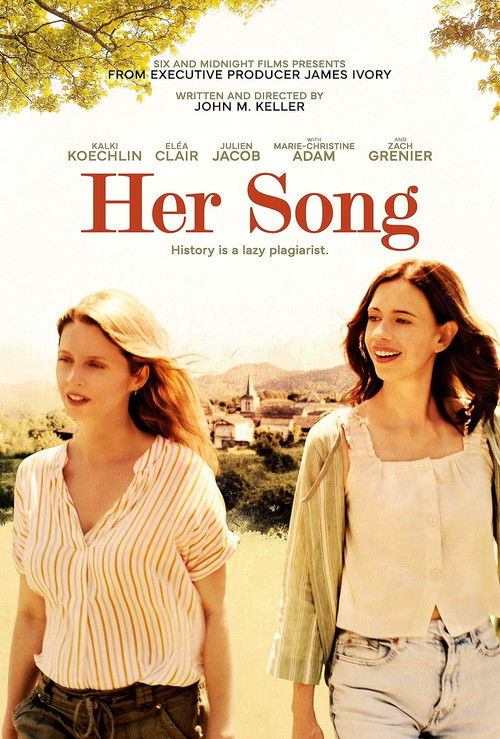
Her Song
Narrative tropes
A Parent's Shadow
highOlivia's entire creative project and identity are defined by her grandmother's legacy — she returns to the ancestral village specifically to complete a novel about her grandmother's WWII flight from Paris. Madeline 'uncannily echoes buried memories of the grandmother,' keeping the predecessor's presence active throughout. The inherited history (grandmother's wartime escape, 'buried memories') is the engine of the central conflict. Olivia's arc is explicitly about navigating the boundary between the grandmother's story and her own present-day life, amounting to an ongoing negotiation between inherited legacy and self-definition.
About this trope: A character must grapple with the legacy of their parents or predecessors — living up to high standards, running from expectations, atoning for inherited sins, or forging their own path.
Cultural messages
The Old Ways Were Better
mediumThe ancestral Pyrenean village is depicted warmly as 'sunlit… ancient stone buildings and rolling landscapes,' implicitly contrasted with Olivia's creatively stagnant NY life. Returning to the ancestral, pre-modern setting directly unlocks her breakthrough; Madeline's artisanal resourcefulness and 'vivid personality' are idealized. The film validates recovering and preserving ancestral memory over modern urban creative stagnation, and frames the pastoral village as the site of truth and renewal.
About this message: Traditional, ancestral, rural, or pre-modern life is portrayed as inherently better than modern alternatives. Progress is corruption, not improvement. The past is idealized as a golden age.
Movies that share these tropes



Full plot (spoilers)
Olivia (Kalki Koechlin), a Franco-American novelist based in New York, returns to her family's ancestral village in the French Pyrenees hoping to finally complete a novel she has struggled with for years — a story about her grandmother, who fled Paris during the Nazi invasion of World War II. In the sunlit village of ancient stone buildings and rolling landscapes, Olivia meets Madeline (Eléa Clair), a radiant, multi-skilled local artisan whose vivid personality and resourcefulness uncannily echo buried memories of the grandmother Olivia never fully knew. Drawn to Madeline, Olivia begins weaving details from her new friend's life directly into the fictional narrative she is constructing about her grandmother's wartime escape. Three storylines gradually overlap and blur: the grandmother's traumatic past in occupied Paris, the novel Olivia is actively writing, and Olivia's own present-day experience of immersing herself in village life and forging a close bond with Madeline. As a series of strange coincidences mount, the boundary between lived reality and invented fiction grows increasingly unstable, and Olivia is forced to ask whether she is shaping history's story or whether history is somehow shaping her. A recurring question — whether there is an inner song within every person, even if they cannot hear it themselves — anchors the film's meditative, conversational tone. The film is characterized by thematic emphasis on a writer's creative anxieties, female perseverance and self-sufficiency, memory and belonging, and the contrast between historical trauma and contemporary pastoral tranquility. Specific details of the climax and resolution are not yet publicly available, as the film's wide release is scheduled for October 16, 2026.
Sources: TMDb overview, India Currents, MerciSF, Letterboxd/High on Films review, Web search metadata