Movie
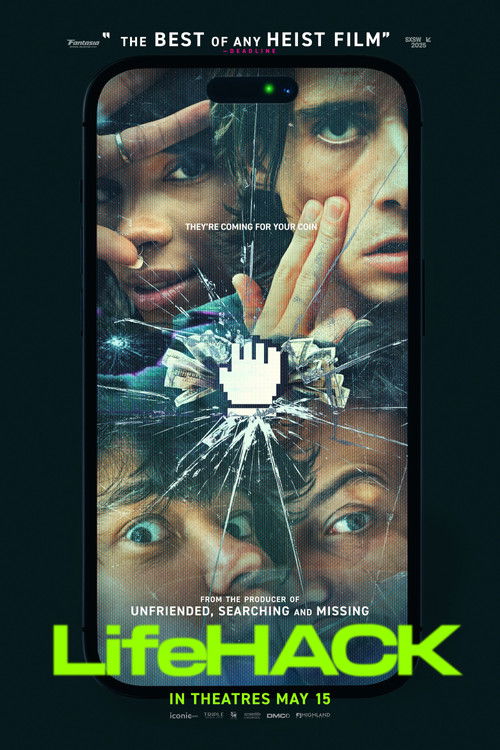
LifeHack
Cultural messages
The Rich Are the Problem
highDon Heard is explicitly framed as an Elon Musk-like caricature (wealthy portrayed negatively). The teens are bedroom-bound slackers targeting a tech billionaire — class divide is the explicit motivation for escalating from pranks to the heist. The protagonists are sympathetic underdogs, while Heard's concentrated crypto wealth signals a system tilted toward the rich. Draining $24–28M from his wallets functions as a redistributive act, paralleling 'revolution or escape from the rich' as resolution.
About this message: Wealthy elites are portrayed as exploitative, callous, or predatory, and extreme inequality is the central injustice driving the story.
Screens Are Ruining Us
mediumLindsey's 'compulsive social-media oversharing' — normal, designed platform behavior — is the exploit vector, making consumer tech's normal use the direct source of harm. The gang spends their days gaming and trolling online (screen-addicted slackers isolated in bedrooms). The arc of 'virtual danger crossing to physical danger' and descending into 'the darkest corners of the internet' maps onto characters losing autonomy and humanity through screen-mediated life.
About this message: Consumer technology — smartphones, social media, VR, the internet — is portrayed as inherently dehumanizing, addictive, or isolating, even when working as designed. The technology doesn't malfunction; its normal use is the problem.
Movies that share these tropes





Full plot (spoilers)
Four teenage slackers — Kyle, the ringleader; Petey, the code monkey; Sid, a reckless hacker; and Alex, a counterfeiter — spend their days gaming and trolling online scammers using their hacking skills. When Kyle convinces the group to level up from pranks to a serious score, they set their sights on Don Heard, a tech billionaire depicted as an Elon Musk-like caricature. The crew exploits Heard's daughter Lindsey, whose compulsive social-media oversharing gives them the foothold they need to breach his cryptocurrency wallets. Working entirely from their bedrooms — the film is told screenlife-style, through computer screens, Discord chats, and surveillance feeds — they successfully drain somewhere between $24M and $28M in Bitcoin, initially believing they've executed the perfect invisible crime. The triumph is short-lived: Lindsey contacts Kyle with an ultimatum, and what began as a thrill-seeking stunt rapidly spirals outward. The gang descends into the darkest corners of the internet, and the danger quickly crosses from virtual to physical. The ending and full resolution are not yet publicly available, as the film had not received wide release as of the time of research (theatrical debut scheduled 2026-05-15). The film is noted as being inspired by true events.
Sources: Wikipedia, TMDb, Collider, Rotten Tomatoes, FirstShowing.net, Variety