Movie
Our Land
Narrative tropes
Rebels vs. The Empire
highThe Right to Roam campaigners are a small, outmatched group challenging the entrenched institutional power of England's land-ownership system (1% own 50% of land, 92% legally off-limits). The activists are framed sympathetically as brave moral agents staging civil disobedience; the opposing side — wealthy estate owners backed by centuries of inheritance law — functions as the 'empire'. The mass trespass events constitute meaningful resistance against overwhelming odds, and the film connects the land regime to colonialism, framing it as cruel and dehumanising.
About this trope: A small outmatched group rises up against a massive oppressive regime or institutional power. The rebellion is framed as morally righteous.
Cultural messages
The Rich Are the Problem
highLand inequality is the film's explicit, statistical foundation: 1% of the population controls half of England's land, leaving 92% off-limits to the public. Wealthy landowners are portrayed as indifferent or hostile to public need, while working-class communities, people of colour, and refugees are the sympathetic excluded parties. The system is shown as structurally designed to protect elite ownership, rooted in colonial and class history. Civil disobedience trespass directly challenges that control, mapping onto the 'revolution or escape' resolution signal. All five C3 signals are present.
About this message: Wealthy elites are portrayed as exploitative, callous, or predatory, and extreme inequality is the central injustice driving the story.
Movies that share these tropes
Full plot (spoilers)
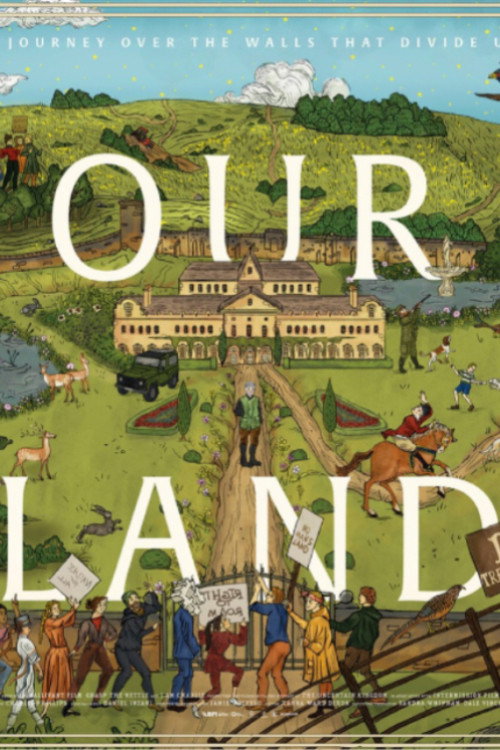
Our Land is an 89-minute British documentary directed by Orban Wallace that follows the Right to Roam campaign as it stages a series of organised mass trespass events across England to demand greater public access to the countryside. The film opens with a stark statistical backdrop: 92% of England's land and 97% of its rivers are legally off-limits to the general public, with half the country's land concentrated in the hands of just 1% of the population. Against this context, the film tracks key figures in the movement — activist Nadia Sheikh, trespass author Nick Hayes (The Book of Trespass), and land-rights researcher Guy Shrubsole (Who Owns England?) — as they organise and lead acts of civil disobedience, walking onto private estates and rivers to assert a public right to nature. Nature writer Robert Macfarlane provides historical perspective, tracing how centuries of inheritance law and property tradition have shaped who can and cannot access the English landscape. The documentary gives equal voice to the opposing side: landowners and estate managers who position themselves as environmental custodians, arguing that unrestricted public access would damage ecologically sensitive habitats already under pressure. The film explicitly connects land exclusion to race and class, examining how barriers to countryside access disproportionately affect people of colour, refugees, and working-class communities, and situating contemporary property rights within a longer history of colonialism and power. The film carries a UK 12 certificate due to discussions about colonialism and racism, including the inclusion of racist and xenophobic remarks encountered by campaigners. The documentary does not resolve the conflict but frames it as a live democratic struggle over competing visions — public entitlement to nature versus private stewardship — leaving the central question of who truly has the right to roam open to the viewer.
Sources: ourlanddocumentary.com, Huck Magazine, orbanwallace.com, Sheffield DocFest, peopleslandpolicy.home.blog