Movie
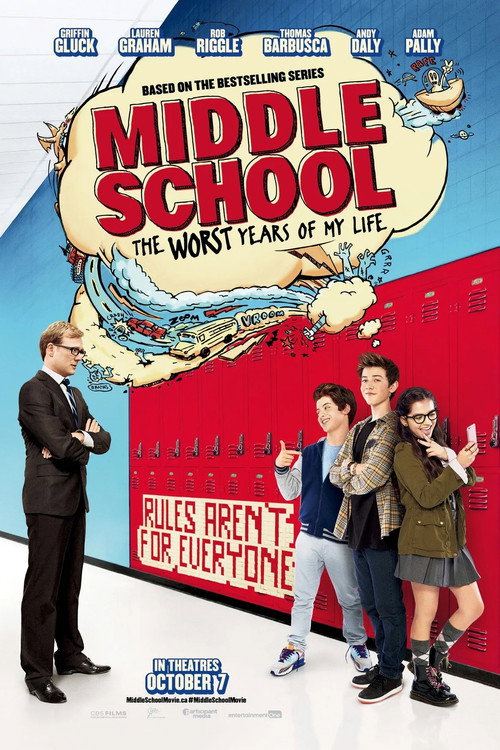
Middle School: The Worst Years of My Life
Narrative tropes
Rebels vs. The Empire
highRafe and a small band of students (Leo, Jeanne, Georgia, classmates) wage Operation R.A.F.E. against the tyrannical Principal Dwight and Vice-Principal Stricker, who are explicitly described as authoritarian and obsessed with control. The rebels are framed as morally righteous throughout; the regime is shown as cruel and dehumanizing (Dwight dissolves Rafe's sketchbook, suspends an entire class to manipulate test scores). All five signals fire: the administration is portrayed as oppressive and corrupt, the student group organizes against overwhelming institutional odds, they are the clear moral heroes, the regime's cruelty is repeatedly shown, and the victory is total—both administrators are fired and publicly humiliated.
About this trope: A small outmatched group rises up against a massive oppressive regime or institutional power. The rebellion is framed as morally righteous.
Cultural messages
The System Is Rigged
highThe school—an institution meant to protect and educate students—is revealed to be actively corrupt: Dwight and Stricker fabricate disciplinary records to rig the standardized testing pool for Dwight's personal bonus. Working within the system fails (Rafe is expelled). True justice requires the children to gather evidence outside official channels and bring it directly to the Superintendent, bypassing the corrupt local authority entirely. Signals present: authority figures are secretly villainous; a cover-up within an official body is exposed; the protagonist is expelled (disavowed) by the institution; official processes fail; and justice only arrives through extrasystemic action.
About this message: Institutions meant to protect people — governments, corporations, law enforcement, the justice system — are depicted as corrupt, incompetent, or actively harmful. Heroes must work outside official channels.
Movies that share these tropes




Full plot (spoilers)
Rafe Khatchadorian, an imaginative aspiring cartoonist, lives with his mother Jules, his rebellious younger sister Georgia, and Jules' boyfriend Carl 'Bear'—a lazy, child-hating man who causes tension at home. Having already been expelled from two schools, Rafe arrives at Hills Village Middle School as a last resort. He is accompanied by his spirited best friend Leo, with whom he shares a vivid inner world. The school is run by the tyrannical Principal Ken Dwight and his officious Vice-Principal Ida Stricker, both obsessed with order and standardized test performance above all else. When Dwight confiscates and destroys Rafe's cherished sketchbook by dissolving it in acid, Rafe snaps. He and Leo devise 'Operation: R.A.F.E.' (Rules Aren't For Everyone)—a systematic campaign to break every rule in the school handbook. Their pranks escalate in ambition: covering the school in sticky notes, filling the teacher's lounge with plastic balls, dyeing Principal Dwight's hair pink, and converting the trophy case into a fish tank. As the high-stakes B.L.A.A.R. standardized test approaches, Dwight suspends Rafe's entire class to manipulate the school's scores and secure his own performance bonus. Rafe retaliates by triggering the building's sprinkler system, a stunt that gets him officially expelled. Meanwhile, Jeanne Galletta, the AV club president and Rafe's growing love interest, uncovers evidence that Dwight and Stricker had fabricated disciplinary records to rig the testing pool. Rafe teams up with Jeanne, Georgia, Leo, and sympathetic classmates to expose the administrators' corruption. Their evidence reaches Superintendent Hwang, leading to both Dwight and Stricker being fired. As Dwight makes his walk of shame out of the school, he is hit with a blast of green hair dye—the final act of Operation R.A.F.E. Rafe then seals the mission by kissing Jeanne, deliberately breaking rule #86 (no public displays of affection). The film closes with an emotional revelation: Leo was never a real person. He was an imaginary friend—Rafe's way of keeping alive the memory of his younger brother, who died of cancer. Leo had been a manifestation of Rafe's grief, and saying goodbye to him marks Rafe beginning to truly heal.
Sources: Wikipedia, OMDb