Movie
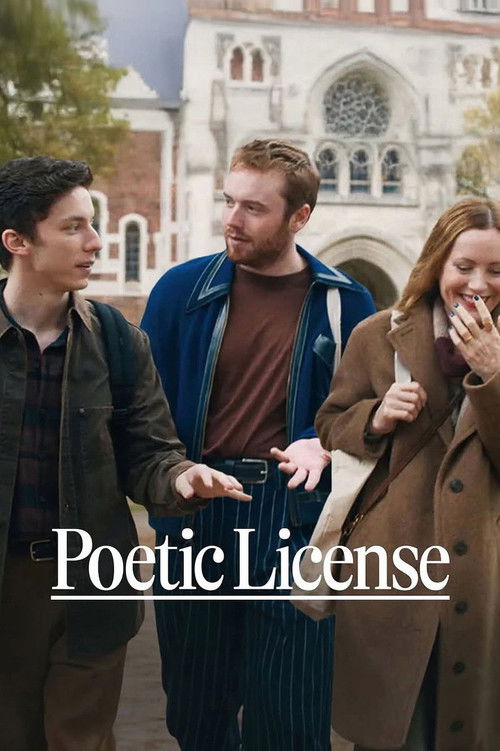
Poetic License
Cultural messages
Be Yourself
mediumLiz suppresses her desire for reinvention while conforming to the neglected empty-nester wife role; Dora similarly struggles to assert herself in an unfamiliar community. Both arcs resolve explicitly through self-acceptance rather than romantic or external rescue, and the film frames conformity as the source of Liz's restlessness and inauthenticity as her central wound.
About this message: A character hides or suppresses their true identity to conform, then finds strength and happiness by embracing who they really are. Authenticity is the real superpower.
Movies that share these tropes





Full plot (spoilers)
Liz (Leslie Mann), a former therapist and soon-to-be empty nester, relocates to a college town after her husband James Cassidy (Method Man) takes a professorship at Braddock University. Adrift and seeking reinvention, Liz audits a poetry class at the university, where she encounters two inseparable college senior best friends: Ari (Andrew Barth Feldman), a dynamic and self-possessed young man, and Sam (Cooper Hoffman), a more buttoned-up type anxious about trading campus life for a finance career at Morgan Stanley. Ari becomes infatuated with Liz almost immediately; Sam's interest follows, and a quiet competition for her attention takes root. Liz, neglected by her own family and gratified by the young men's admiration, does not actively pursue either but is drawn into the emotional tangle. A layer of ethical complication surfaces when it becomes clear that her husband is Sam's professor on campus. As the semester progresses, the rivalry intensifies and the two friends' previously solid bond deteriorates under its strain. Parallel to this, Liz mediates and occasionally meddles in the adjustment of her teenage daughter Dora (Chloe East), who is also finding her footing in the unfamiliar community. The film frames the romantic triangle less as a literal love story and more as a vehicle for examining life-stage paralysis: Liz confronting the gap between the life she has built and the one she still craves, while Ari and Sam grapple with post-graduation anxiety. The film concludes with both Liz and Dora independently stepping forward into new chapters, suggesting emotional growth and self-acceptance rather than a conventional romantic resolution. Directed by Maude Apatow in her feature directing debut.
Sources: Web search aggregation, Moveable Fest review (TIFF 2025), SHIFTER review, Geek Vibes Nation review, Flickering Myth review, Rotten Tomatoes synopsis, Wikipedia (partial — production-focused)