Movie
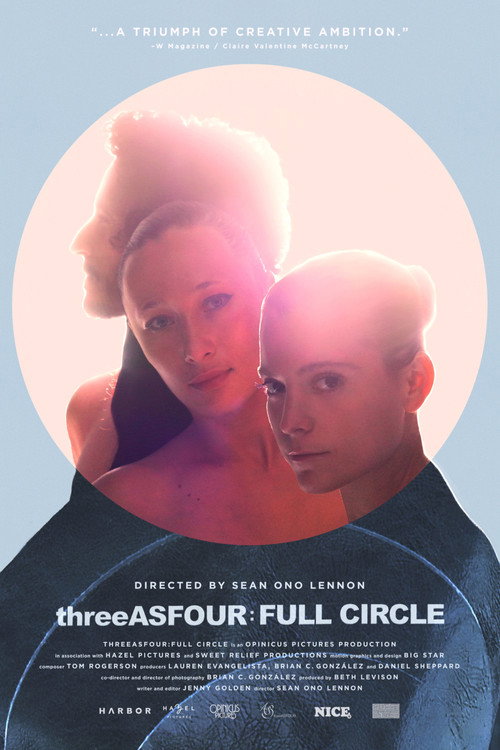
threeASFOUR: FULL CIRCLE
Narrative tropes
Humans Never Give Up
highThe collective perpetually struggles to pay rent, loses their studio, and faces chronic commercial non-viability despite critical acclaim — objectively hopeless circumstances. They keep going: finding a new home at Mana Contemporary, launching a denim line, continuing experimental collections. The director explicitly frames the film as 'a meditation on friendship, resilience, and the pursuit of peace and creativity,' and the post-credits montage of yearly collections is presented as proof that sustained effort — not triumph — is the point. Hope and creation persist where commercial logic would counsel surrender.
About this trope: Facing impossible odds, humans endure, adapt, and find reasons to keep going. Resilience and refusal to surrender is humanity's defining and most admirable trait.
Movies that share these tropes





Full plot (spoilers)
threeASFOUR: FULL CIRCLE is a documentary directed by Sean Ono Lennon (his feature directorial debut) chronicling the avant-garde New York City fashion collective threeASFOUR — comprising Gabi Asfour (Lebanese-Palestinian), Angela Donhauser (Tajik-Russian), and Adi Gil (Israeli) — over more than two decades of collaboration and roughly five years of filming. The film opens in the present before flashing back to the trio's Winter 2012 collection, then traces their journey through successive runway seasons, immediately juxtaposing each acclaimed show with hard questions about commercial viability. The collective's intricate, geometry-driven creations — enabled in part by state-of-the-art 3D printing — have earned devoted celebrity admirers including Björk, Rihanna, Marisa Tomei, and Chloë Sevigny, yet the designers perpetually struggle to pay rent on their Chinatown studio, known as The Silver Cage. The central dramatic tension is philosophical as much as financial: Asfour champions radical experimentation ('If you make something, it has to stand out — so you create something that doesn't exist'), while Donhauser argues that wearability and accessibility are equally vital to their artistic mission. The film documents both the strength of this creative partnership and the moments where it is tested. A key inflection point is the loss of The Silver Cage itself; in its aftermath, the trio finds an unexpected opportunity to establish a fashion incubator at Mana Contemporary in Jersey City. They also attempt to bridge experimentation with commercial reality by launching a denim line. An emotional interview with former member Kai Kühne, who departed in 2005, adds historical perspective on the collective's evolution. Director Lennon weaves in his own perspective as a fellow artist who recognizes his creative frustrations reflected in theirs, framing the film as 'a meditation on friendship, resilience, and the pursuit of peace and creativity.' The film closes with a post-credits montage of yearly collections, quietly underscoring the sustained effort required simply to keep making work. The documentary's multicultural makeup — Palestinian, Israeli, Russian, Tajik — is presented as inseparable from threeASFOUR's identity and their philosophy of fashion as cultural connection.
Sources: Tribeca Film Festival official page, Moveable Fest review, 48hills review, Web search aggregation (Letterboxd, Film Forum, VIMooZ, FirstShowing)