Movie
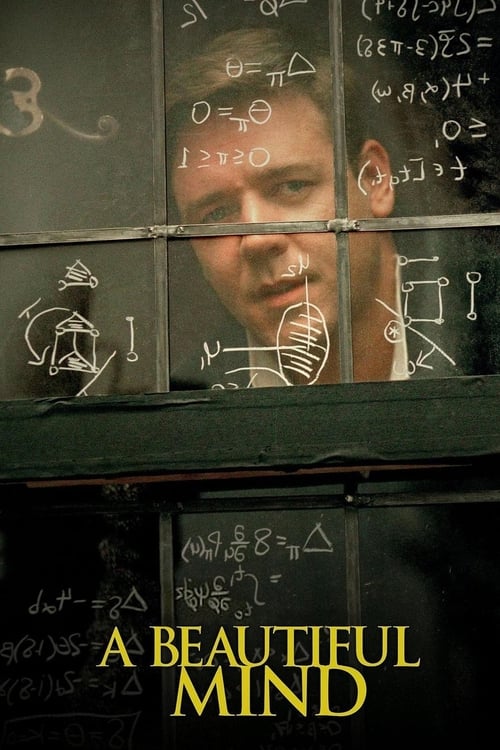
A Beautiful Mind
Narrative tropes
Humans Never Give Up
highNash faces objectively hopeless circumstances—paranoid schizophrenia whose hallucinations never fully resolve—yet refuses re-institutionalization when doctors recommend it and chooses to manage the illness through willpower alone. Survival against these impossible odds is the entire central arc. The emotional turning point is Nash's decision to keep going (consciously ignoring hallucinations) rather than the Nobel victory itself. His chosen path is explicitly contrasted with the medically 'rational' approach of drugs and institutionalization, and the final image of hallucinations still present but ignored frames his stubbornness as the heroic stance.
About this trope: Facing impossible odds, humans endure, adapt, and find reasons to keep going. Resilience and refusal to surrender is humanity's defining and most admirable trait.
Love Conquers All
mediumAlicia's sustained devotion is the force that keeps Nash functional where medicine fails. Nash's love for Alicia is the pivotal plot mechanism: Parcher urges him to attack her, and in that charged moment his recognition of the danger to someone he loves is what breaks through the delusion. Nash credits Alicia explicitly in his Nobel acceptance speech as the source of his achievement, and the film closes on that dedication—framing love as the decisive force that overcame schizophrenia when nothing else could.
About this trope: Love — romantic, familial, or platonic — is presented as the ultimate force that overcomes any obstacle including death, physics, evil, or cosmic forces. Love is a literal power.
Cultural messages
Family Is Everything
mediumThe family unit—Nash, Alicia, and their infant son—is the central stake. The illness directly imperils the family (infant left unattended in bathtub; Nash nearly strikes Alicia). The resolution hinges on Nash choosing to remain with his family rather than accept institutionalization, and his long road back to academia is sustained by Alicia's refusal to leave. The Nobel speech dedication and the final shot of Nash departing with his family confirm family bonds as the bedrock of his recovery.
About this message: Family bonds — biological or found — are ultimately what saves the day, provides meaning, and matters most. Characters who stray from family suffer; those who return are rewarded.
Hard Work Always Pays Off
mediumNash's schizophrenia functions as a severe structural/neurological barrier that he overcomes primarily through individual determination—refusing medication, refusing institutionalization, and training himself to ignore hallucinations through willpower alone. The story validates this choice: the Nobel Prize rewards his mathematical merit, confirming that effort and grit triumph over circumstance. Systemic support (psychiatry, medication) is shown as insufficient; personal resolve is what ultimately pays off.
About this message: Hard work, talent, and determination are reliably rewarded. The system is fundamentally fair — those who didn't succeed didn't try hard enough. Structural barriers are overcome by willpower alone.
Movies that share these tropes





Full plot (spoilers)
In 1947, John Forbes Nash Jr. arrives at Princeton University on a mathematics scholarship, socially awkward and intensely competitive. He befriends roommate Charles Herman and, after observing the social dynamics among his classmates at a bar, formulates his groundbreaking 'Nash equilibrium' game theory, earning him a coveted position at MIT. By 1953, Nash is approached by the mysterious William Parcher, a shadowy figure from the Department of Defense, who recruits him for classified cryptographic work: scanning newspapers and magazines to identify hidden Soviet communication patterns. Nash is told an encoded diode has been implanted in his arm, through which he receives instructions and gains access to a covert dead-drop location. He becomes increasingly obsessed with the assignment. At MIT, Nash falls in love with one of his graduate students, Alicia Larde, and they marry. His paranoia deepens until, during a lecture at Harvard, government agents attempt to detain him; Nash flees in terror before being forcibly sedated and taken to a psychiatric facility. His doctor, Dr. Rosen, diagnoses him with paranoid schizophrenia and reveals a devastating truth: Charles, his old Princeton roommate; Marcee, Charles's young niece; and William Parcher are all hallucinations — none of them exist. Alicia visits the supposed dead-drop location and finds only a shed stuffed with unopened envelopes full of Nash's so-called 'decoded' documents, confirming the delusion. Shattered, Nash attempts to cut open his own arm searching for the nonexistent implanted diode. He undergoes a course of insulin shock therapy and is released on antipsychotic medication, but the debilitating side effects — including loss of intellectual focus and sexual drive — cause him to stop taking his pills without telling Alicia. In 1956, Alicia discovers Nash has left their infant son unattended in a bathtub, convinced Charles is watching the baby. Nash nearly strikes Alicia when Parcher appears urging him to attack her; in that moment Nash recognizes the tell: Marcee, who first appeared as a child, has never aged a single day. He understands that she, and by extension all his hallucinations, cannot be real. He refuses further institutionalization and instead resolves to live with the hallucinations while consciously ignoring them. He returns to Princeton, initially an outcast but gradually tolerated by faculty who allow him to audit and later teach classes. By the late 1970s he is back in academia. In 1994, Nash is awarded the Nobel Memorial Prize in Economic Sciences for his equilibrium theory. In his acceptance speech he dedicates the honor to his wife, Alicia, whose devotion sustained him. As the film closes, Nash departs with his family — and his hallucinations are still present, watching from afar, but he walks past them without acknowledgment.
Sources: Wikipedia