Movie
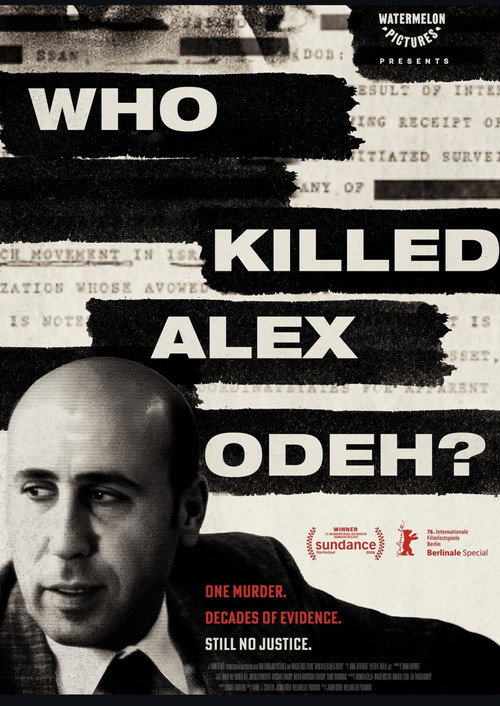
Who Killed Alex Odeh?
Narrative tropes
You Can't Trust Anyone
highThe documentary reveals that institutions the Odeh family and investigators trusted — U.S. law enforcement and the State Department — were covertly working against the pursuit of justice, while Mossad interference constituted a foreign betrayal of domestic law enforcement. The suppression was hidden within ostensibly legitimate government channels. The film's thesis is that this betrayal was systematic and deliberate, validating the paranoia that something was being concealed: four signals apply (trusted institution secretly compromised, hidden conspiracy within official channels, suppression validated by declassified documents, the true obstacle hiding inside the state apparatus itself).
About this trope: Trusted allies, institutions, or authority figures are secretly working against the protagonist. Paranoia is justified because betrayal is real and pervasive.
Cultural messages
The System Is Rigged
highThe FBI identified three JDL suspects yet made no arrests; U.S. State Department officials actively discouraged law enforcement from pursuing them for geopolitical reasons; Mossad interference shut down the investigation entirely. After 40 years, the case remained cold because working within official channels failed. Justice required an independent journalist operating entirely outside institutional structures, who achieved the film's key breakthrough (the Fuchs recording) with no help from law enforcement. All five signals fire: authority figures are willfully complicit, a cover-up within official bodies is exposed, the protagonists are effectively opposed by their own government, the system repeatedly fails, and truth only emerges through extrajudicial action.
About this message: Institutions meant to protect people — governments, corporations, law enforcement, the justice system — are depicted as corrupt, incompetent, or actively harmful. Heroes must work outside official channels.
Movies that share these tropes

Full plot (spoilers)
Who Killed Alex Odeh? is an 84-minute investigative documentary directed by Jason Osder and William Lafi Youmans that reopens the unsolved 1985 assassination of Palestinian American activist Alex Odeh. On October 11, 1985, Odeh — a poet, teacher, and Western Regional Director of the American-Arab Anti-Discrimination Committee (ADC) — was killed when a tripwire pipe bomb exploded as he opened the door to his Santa Ana, California office. Several bystanders were also injured. The attack occurred in a period of heightened anti-Arab sentiment: the night before, Odeh had appeared on local television to comment on the Achille Lauro hijacking, and the broadcaster's editing misrepresented his remarks to make him appear to condone violence when he had in fact condemned it. He had been scheduled to speak at a synagogue the following day. The FBI classified the bombing as a terrorist act and identified three primary suspects tied to the Jewish Defense League (JDL): Robert Manning, Andy Green, and Keith 'Israel' Fuchs. Despite this, no arrests were made in the Odeh case — the suspects fled to Israel, and the documentary presents evidence that U.S. State Department officials discouraged American law enforcement from pursuing them for geopolitical reasons, and that Mossad interference shut down the investigation. Manning was eventually extradited and convicted for a separate 1980 bombing, receiving a life sentence (he was paroled in 2024), but the Odeh murder remained officially cold. The film uses a cold-case true-crime structure, combining archival footage, declassified FBI documents, and firsthand testimony from Odeh's widow Norma and daughter Helena — both of whom are still actively seeking justice. The narrative then shifts into a contemporary vérité investigation following Israeli journalist David Sheen, who independently resurrects the case. The documentary's most dramatic revelation comes when Sheen locates Keith Fuchs in Israel, poses as an Orthodox Jew to gain his trust, and captures Fuchs voluntarily discussing his violent past on a hidden microphone. Beyond the individual crime, the film argues that a systemic bias against Palestinian narratives — in American media, law enforcement, and politics — created an environment in which the murder of a Palestinian American could be suppressed and forgotten. It connects the Kahanist extremism behind the JDL of the 1980s to political movements that persist today. The film won a Special Jury Award for Journalistic Excellence at the 2026 Sundance Film Festival and also screened at the Berlin International Film Festival.
Sources: Wikipedia (Who Killed Alex Odeh? article), Wikipedia (Alex Odeh article), Screen Rant review, POV Magazine review, Watermelon Pictures distributor page, Rotten Tomatoes, MUBI, DC/DOX festival page, San Francisco Jewish Film Festival guide, Letterboxd