Movie
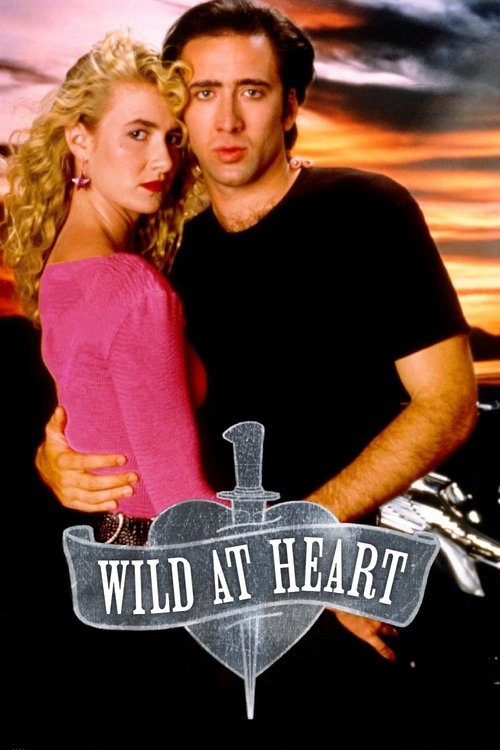
Wild at Heart
Narrative tropes
Love Conquers All
highRomantic love between Sailor and Lula is the film's explicit driving force and resolution mechanism. All three core conditions are met: love is the central story element, love is the literal mechanism of resolution (a supernatural Wizard of Oz vision urges Sailor not to abandon it), and love is portrayed as the supreme force — it overcomes imprisonment, a murder conspiracy, Marietta's obsession, and Sailor's own self-destructive impulse to leave. The climax (Sailor sprinting to Lula, climbing the car, singing Elvis) is driven by nothing but love. Five signals fire: love motivates the decisive heroic act; a character (Sailor) is saved from a darkness of his own making by love; the supernatural Oz vision explicitly names love as the truth he must not refuse; the story frames love as more powerful than any external threat; and the emotional payoff is the lovers' reunion.
About this trope: Love — romantic, familial, or platonic — is presented as the ultimate force that overcomes any obstacle including death, physics, evil, or cosmic forces. Love is a literal power.
Cultural messages
Family Is Everything
highFamily bonds — specifically the Sailor/Lula/Pace unit — are the mechanism of final resolution. All three core conditions are met: family is central, repeated separations (prison, distance, Sailor's abandonment) constitute the threat, and reunion resolves the story. Four signals fire: family reunion is the emotional climax; Sailor chooses to return to his family over self-imposed exile; Pace's birth while Sailor is incarcerated creates the family unit whose incompleteness drives the ending; and Lula driving to collect Sailor frames family restoration as the journey's entire purpose.
About this message: Family bonds — biological or found — are ultimately what saves the day, provides meaning, and matters most. Characters who stray from family suffer; those who return are rewarded.
Be Yourself
mediumSailor's snakeskin jacket is explicitly described as a symbol of his individuality and rebellion, and Lula restoring it to him at his release frames the film around authentic identity from the outset. The core suppression/reclamation arc is present though concentrated in the final act: Sailor suppresses his true identity as Lula's partner by abandoning her, and Glinda's vision is the turning point that calls him back to himself. Three signals fire: authenticity is symbolized by the jacket and his spontaneous Elvis performances; conformity pressure (parole, Marietta, criminality) is shown as the antagonistic force; and happiness flows directly from reclaiming his authentic self at the reunion.
About this message: A character hides or suppresses their true identity to conform, then finds strength and happiness by embracing who they really are. Authenticity is the real superpower.
Movies that share these tropes





Full plot (spoilers)
In Cape Fear, North Carolina, Sailor Ripley and Lula Fortune are young lovers torn apart when Sailor is imprisoned for killing Bobby Ray Lemon, a man hired by Lula's controlling, manipulative mother Marietta Fortune to attack him. After 22 months, Sailor is released and Lula greets him with his beloved snakeskin jacket — a symbol of his individuality and rebellion. The two celebrate at a speed metal club where Sailor spontaneously performs an Elvis Presley song with the band Powermad. Defying his parole conditions, Sailor proposes they flee together toward California to start a new life. Marietta, furious and obsessive, hires private detective Johnnie Farragut — her lover — to track the couple down. Simultaneously, she contracts gangster Marcello Santos to murder Sailor. Santos escalates the job to mob boss Mr. Reindeer, and Farragut is added to the kill list, sending Marietta into guilt-ridden distress. Farragut is eventually captured and killed in New Orleans. On the road, Sailor and Lula witness a gruesome traffic accident in which a young woman — badly brain-damaged and bleeding — stumbles out of a wrecked car and dies before them. Lula takes this as a terrible omen. Her unease deepens when she comes to suspect that Sailor may have witnessed the murder of her father. Short on money, Sailor seeks out an old acquaintance, Perdita Durango, in the desolate town of Big Tuna, Texas. At a party there, Lula announces she is pregnant. While Sailor is working on their car, the menacing Bobby Peru arrives at their motel room, intimidates Lula, and sexually coerces her — a deeply traumatic act given that Lula was raped as a child. Peru then recruits an unwitting Sailor for what he presents as a simple robbery of a feed store. During the heist, Peru shoots the store clerks and reveals he holds a murder contract on Sailor. The confrontation ends chaotically: Peru is shot by an arriving sheriff's deputy and in the struggle accidentally blows off his own head with his shotgun. Sailor is arrested and sentenced to six more years in prison for his role in the robbery. While he is incarcerated, Lula gives birth to their son, Pace. When Sailor is finally released, Lula drives to Los Angeles to collect him — but Sailor, convinced he is a destructive force in their lives, abandons her and Pace, telling them they are better off without him. Walking alone, he is set upon by a street gang and beaten unconscious. In a surreal vision reminiscent of The Wizard of Oz, Glinda the Good Witch appears to him and urges him not to turn away from love. Sailor wakes, apologizes to his bewildered attackers, and sprints after Lula's car. He climbs onto the hood, and — echoing his gesture from the beginning of their journey — sings an Elvis song to her. The family is reunited.
Sources: Wikipedia