Movie
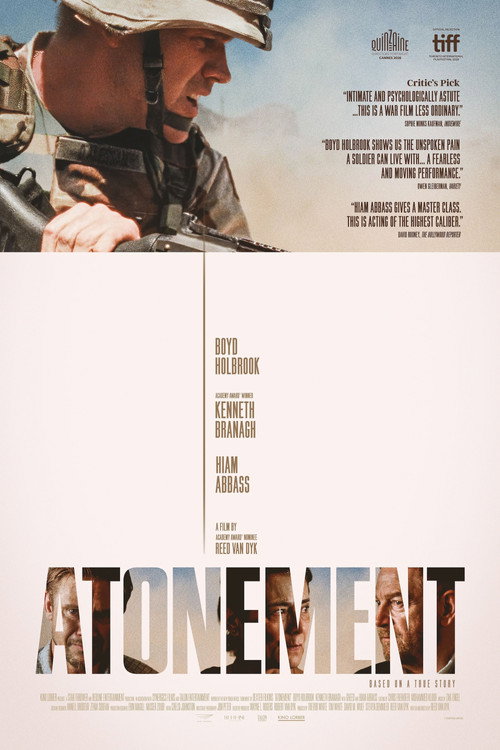
Atonement
Cultural messages
Forgiveness Sets You Free
highThe entire film is structured around whether forgiveness and reconciliation are possible between Lou (the Marine who killed Mariam's husband and sons) and the surviving family. The title 'Atonement' signals the theme explicitly. Signal 1: the culminating encounter between Lou and the family is a direct climactic moment of potential mercy over vengeance. Signal 2: Lou's PTSD and guilt drive years of ongoing suffering — the pursuit of atonement is framed as the only path forward. Signal 3: the three-chapter structure leads deliberately toward the encounter as the mechanism of potential healing for both parties. Signal 4: Lou's proactive search for the family (via journalist Michael Reid) frames letting go and seeking reconciliation as the harder but necessary path, contrasted with his decade of paralysis.
About this message: Forgiving — even the unforgivable — is presented as the path to peace and healing. Holding grudges is self-imprisonment; releasing them is liberation.
Movies that share these tropes





Full plot (spoilers)
Set during and after the 2003 invasion of Iraq, Atonement opens with the daily life of the Khachaturian family — Armenian-Iraqi Christians living in Baghdad. When U.S. forces advance and violence escalates, the family attempts to navigate the city's war-torn streets to reach safety. At a Baghdad intersection, their vehicle is caught in a confrontation between U.S. Marines and suspected insurgents. Marines, including Lance Corporal Lou D'Alessandro, open fire on the approaching vehicle in a split-second decision, killing the family's father and two sons and wounding daughter Nora in the shoulder. The attack also leaves Nora's infant son without a father.
More than a decade later, Lou, now a civilian in San Diego studying law after receiving an other-than-honorable discharge for drug use (stemming from inadequate post-combat mental health care), remains tormented by PTSD and guilt over his role in the shooting. After a fellow Marine's suicide prompts renewed soul-searching, Lou reaches out to journalist Michael Reid — who reported on the original incident — seeking help locating the surviving family members. Michael, played by Kenneth Branagh, agrees to facilitate contact.
The surviving family — Mariam, the matriarch who lost her husband and two sons, and her daughter Nora — have relocated to Glendale, California. Mariam continues her domestic routines, grief absorbed into daily life. Lou and Michael eventually reach the women, and the film culminates in an attempted encounter and reckoning between the Marine responsible for the shooting and the family he devastated, exploring whether forgiveness or any meaningful reconciliation is possible.
The film is structured in three chapters, each adopting a different character's point of view: first the Khachaturian family's life before the attack (establishing them as full human beings outside the lens of American occupation), then Lou's and Michael's perspectives covering the post-war years and the search for the family, and finally Mariam's point of view as the encounter unfolds. Critics note the film devotes roughly two-thirds of its runtime to the American male perspective before shifting to the Iraqi family.
Sources: Wikipedia, The Film Stage (TIFF review), LWLies (Cannes review), Web search metadata (TMDb, search snippets)