Movie
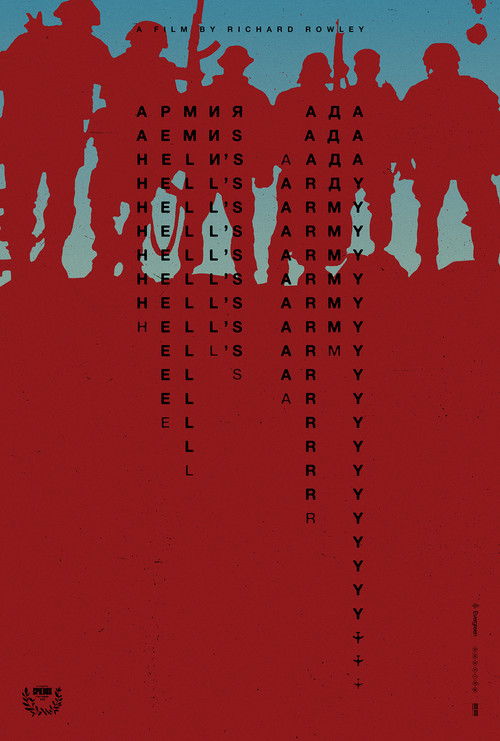
Hell's Army
Cultural messages
The System Is Rigged
highThe Russian state — an institution ostensibly bound by law — is exposed as Wagner's sponsor and protector, making official accountability impossible. Both protagonists are exiles or dissidents working entirely outside official channels. Three of their colleagues were murdered with no state accountability. The film ends not with justice but with a warning that the mercenary model is spreading globally, confirming that working within or through any institutional framework has failed and continues to fail.
About this message: Institutions meant to protect people — governments, corporations, law enforcement, the justice system — are depicted as corrupt, incompetent, or actively harmful. Heroes must work outside official channels.
The Rich Are the Problem
mediumPrigozhin is explicitly profiled as an oligarch who deployed mercenary violence as an instrument of resource extraction — seizing gold-mining territories in the Central African Republic while propping up authoritarian governments. The film's concluding thesis is that 'oligarch-controlled mercenary violence' is the spreading model, framing concentrated private wealth as the engine of exploitation. The victims (populations in CAR, Syria, Ukraine) are poor and powerless against this wealthy-backed force.
About this message: Wealthy elites are portrayed as exploitative, callous, or predatory, and extreme inequality is the central injustice driving the story.
Movies that share these tropes





Full plot (spoilers)
Hell's Army is a documentary following Russian dissident journalist Katya Hakim and exiled investigative reporter Denis Korotkov as they pursue the Wagner Group mercenary army across multiple continents. Hakim, a war-scarred reporter who had been covering Syria, is drawn into the investigation when she encounters evidence of Wagner's clandestine operations there. She and Korotkov partner to trace the origins and reach of Yevgeny Prigozhin's private military apparatus — a force that grew from obscure beginnings into what the film describes as the first private company to conquer a European city in five centuries, eventually deploying around 30,000 fighters simultaneously. Prigozhin himself is profiled from his Soviet-era prison years through his rise as Putin's caterer and oligarch, to his command of a force active in Ukraine (including the brutal siege of Bakhmut), Syria, and sub-Saharan Africa. In the Central African Republic, the journalists document how Wagner propped up authoritarian governments while seizing gold-mining territories, an investigation that cost three of their colleagues their lives — murdered while exposing these operations. As the reporting expands, Hakim and Korotkov face sustained death threats. The film reaches a pivot when Prigozhin launches a brief insurrection in 2023 — tank columns advancing on Moscow and military aircraft shot down — before abruptly standing down. He is killed in a plane crash shortly afterward, widely understood as state retaliation. Rather than providing closure, his death forces the journalists to confront a more disturbing conclusion: the Wagner model of oligarch-controlled mercenary violence has metastasized globally, with other authoritarian actors adopting it as an instrument of resource extraction and political control. The film ends as an urgent warning that this darkness is spreading beyond Russia.
Sources: Wikipedia, Democracy Now interview/screening coverage, Web search aggregation (Deadline, Hollywood Reporter, Variety, Screen Daily summaries)