Movie
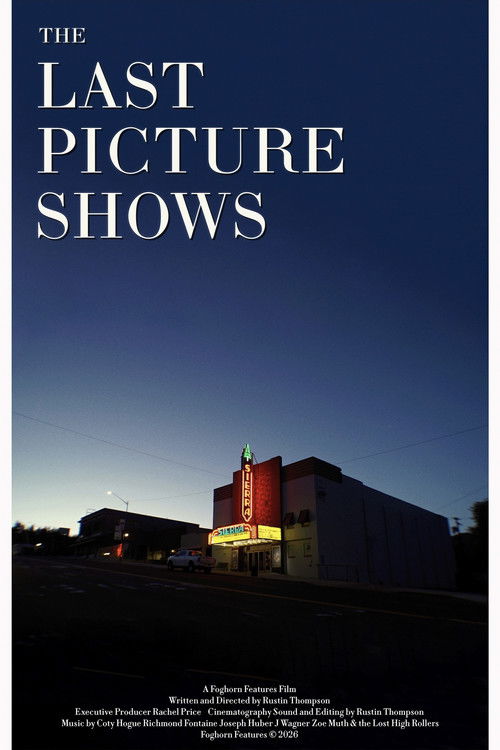
The Last Picture Shows
Narrative tropes
Humans Never Give Up
highThe documentary's central subject is theater operators who refuse to quit against objectively hopeless odds: half the venues Thompson visits are already closed, the industry has been decimated by TV, costly digital conversion, streaming, and the pandemic. Yet Tiny Pedersen works a separate full-time job to keep the Desert Theatre open, Jerry Lussy has operated the Washoe for 36 years, and Cody Jones actively rescued the Seeley. Thompson's thesis — earned through surprise — is that passionate caretakers sustain 'oases of wonder, contemplation, and connection' despite market logic saying otherwise. The emotional payoff is the decision to persist, not economic victory. On-screen titles confirm survival as triumph.
About this trope: Facing impossible odds, humans endure, adapt, and find reasons to keep going. Resilience and refusal to surrender is humanity's defining and most admirable trait.
Cultural messages
The Old Ways Were Better
mediumThe film consistently depicts communal, small-town movie theaters — many century-old or art deco — with reverence and warmth (glowing marquees against desert highways, archival images), while framing each wave of modernization as loss: television, the digital conversion mandate, streaming competition, and studio short-window demands are all portrayed as destructive forces. The conversion of the Chief Theatre into a Subway restaurant and the demolition of the Elma Theatre during production are presented as unambiguous cultural degradations. The story validates preserving these older communal spaces as morally essential ('the community needs it'), meeting the core B3 pattern of favorable traditional depiction versus unfavorable modern contrast.
About this message: Traditional, ancestral, rural, or pre-modern life is portrayed as inherently better than modern alternatives. Progress is corruption, not improvement. The past is idealized as a golden age.
Movies that share these tropes




Full plot (spoilers)
The Last Picture Shows is a 2026 documentary in which Seattle-based Emmy-winning filmmaker Rustin Thompson embarks on a road trip across ten U.S. states, covering 10,825 miles and visiting 123 small-town movie theaters. Structured in six chapters, the film was initially conceived as a dark meditation on cinema's decline, but Thompson's journey reshapes it into a more nuanced portrait of loss, resilience, and community devotion. Roughly half the theaters he encounters are closed, converted to other uses (one, the Chief Theatre in Tonasket, Washington, is now a Subway restaurant), or demolished — including the Elma Theater in Washington, torn down during the film's production in 2026. Thompson documents the forces that have battered the exhibition industry over decades: the rise of television, the costly mid-2000s digital conversion, the predatory short-window demands of major studios (illustrated through a case study involving a mandated Shazam! Fury of the Gods engagement despite poor attendance), intensifying streaming competition, and the devastating 2020–2021 pandemic lockdowns. Drive-in theaters receive particular attention as emblems of an accelerated decline — from roughly 8,000 operating venues at their peak to approximately 400 remaining nationwide. Yet the film continually pivots toward the survivors and the people behind them. Thompson interviews Tiny Pedersen of the Desert Theatre in Burns, Oregon (open since 1948), who holds a separate full-time job to keep the theater running, explaining simply that 'the community needs it.' Jerry Lussy, who has operated the art deco Washoe Theatre in Anaconda, Montana for 36 years, reflects that theaters 'have a purpose: to take care of people.' The documentary also profiles Cody Jones, a young owner who rescued the Seeley Theater in Pomeroy, Washington; Larry Hibbard of the century-old Ruby Theatre in Chelan, Washington; and Jared Alexander of the El Morro Theater in Gallup, New Mexico, among others. Film historian and cinematreasures.org co-founder Ross Melnick provides historical context throughout. Thompson intersperses his road footage — serene shots of glowing marquees against desert highways, abandoned auditoriums, and archival early-20th-century images — with clips from Peter Bogdanovich's 1971 film The Last Picture Show (the documentary's primary intertextual anchor), as well as Cinema Paradiso and Rio Bravo. These excerpts function as elegiac counterpoints that frame the theaters not merely as real estate but as repositories of communal memory and cinematic culture. The film concludes with on-screen titles confirming that every featured venue still operating at time of filming survived, and that some shuttered theaters were subsequently acquired by movie-loving proprietors who reopened them. Thompson's thesis, earned through surprise rather than assumed at the outset, is that even in vast cinema deserts, passionate caretakers sustain oases of wonder, contemplation, and connection.
Sources: Loud and Clear Reviews, Film Threat, Camas-Washougal Post-Record, The Spokesman-Review