Movie
E.T. the Extra-Terrestrial
Narrative tropes
Love Conquers All
highLove is the literal mechanism of resolution: E.T. appears to die, and it is Elliott's declaration of love that coincides with E.T.'s revival. Love motivates every decisive act (hiding E.T., the ambulance theft, the bike chase). The psychic bond transcends death and physical separation. The film explicitly frames the emotional connection as more powerful than the government's medical intervention.
About this trope: Love — romantic, familial, or platonic — is presented as the ultimate force that overcomes any obstacle including death, physics, evil, or cosmic forces. Love is a literal power.
Kids See the Truth
highAll three children immediately trust and bond with E.T. while adults either remain oblivious (Mary) or treat him as a specimen (government agents). Elliott's instinct to befriend rather than fear E.T. drives the entire plot and proves correct. The children's simple moral clarity — E.T. is a friend who needs to go home — is what actually succeeds where institutional science fails. Innocence functions as the decisive form of wisdom.
About this trope: Children possess intuitive wisdom, moral clarity, or a connection to truth that cynical adults have lost. Kids see through lies, sense danger, and understand what really matters.
Rebels vs. The Empire
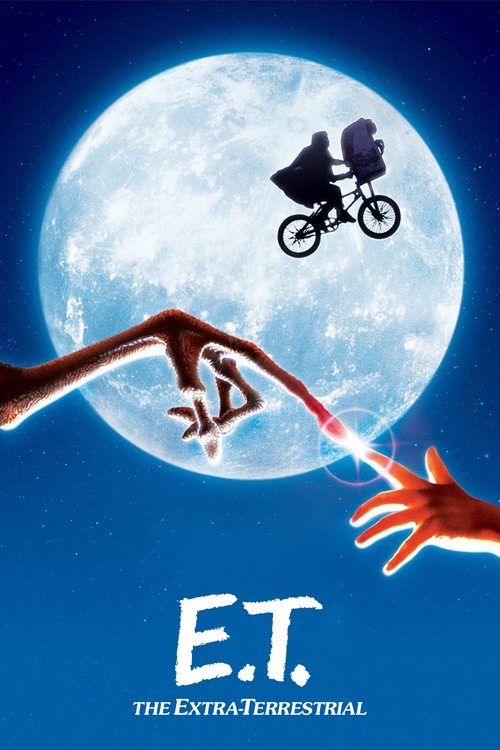
highA clear power imbalance pits a handful of children and a single alien against a fleet of government agents with vehicles, surveillance equipment, and institutional authority. The children are framed as morally righteous; the agents quarantine the family home and treat E.T. as a scientific asset. The climax — kids on bicycles levitating over a government roadblock — literalizes the underdog escape, and E.T. successfully boards his ship, denying the regime its objective.
About this trope: A small outmatched group rises up against a massive oppressive regime or institutional power. The rebellion is framed as morally righteous.
Cultural messages
Family Is Everything
highThe central engine of the plot is E.T.'s separation from his family/crew and his drive to return home. Elliott's family rallies around E.T. as a found-family member. The emotional climax is the farewell reunion with his ship. 'Phone home' and the final ascent echo 'there's no place like home.' Elliott ultimately sacrifices keeping E.T. so the alien can return to where he belongs.
About this message: Family bonds — biological or found — are ultimately what saves the day, provides meaning, and matters most. Characters who stray from family suffer; those who return are rewarded.
What Makes Us Human?
highE.T. heals wounds, revives flowers, forms a deep psychic bond, and expresses grief and love — exhibiting more empathy than the institutional humans who quarantine his surrogate family and study him as a specimen. The government scientists treat him as an object; the children treat him as a person. E.T.'s revival and farewell — touching Elliott's forehead, leaving a rainbow — implicitly argues that this alien possesses soul and humanity that the adults' rational framework cannot recognize.
About this message: As the line between humans and non-humans blurs — AI, clones, aliens, robots — the story forces a reckoning with what truly defines humanity: biology, consciousness, memory, emotion, or moral choice.
Science vs. Faith
highThe government's medical-scientific intervention fails to save E.T. (he appears to die under their care). Elliott's emotional, intuitive leap — declaring love for what looks like a dead creature — is the moment E.T. revives. Science is depicted as cold and insufficient: the agents quarantine, probe, and lose the patient. The children, guided by feeling rather than method, succeed. E.T.'s revival has no scientific explanation and functions as vindication of intuition over rationalism.
About this message: Characters face a choice between rational/scientific thinking and spiritual/intuitive belief. The story typically validates faith or emotion over cold logic — the scientist is wrong, the believer is vindicated.
Movies that share these tropes





Full plot (spoilers)
A group of small, plant-collecting aliens visits a California forest at night. One member becomes separated from the others when government agents arrive, and the spacecraft departs without him. The stranded creature takes refuge in a shed belonging to ten-year-old Elliott Taylor, a boy living with his single mother Mary and his older brother Michael and younger sister Gertie. Elliott initially frightens the alien off, but lures him back with Reese's Pieces candy and hides him in his bedroom. He names the creature E.T. After introducing E.T. to Michael and Gertie, the three children agree to keep his existence secret from their mother. E.T. displays remarkable abilities: he uses telekinesis to show Elliott a model of his home planetary system, revives a pot of wilting flowers, and heals small wounds. As their bond deepens, Elliott and E.T. develop a psychic link that causes them to share emotions and sensations. When E.T. drinks beer at home, Elliott becomes intoxicated at school; inspired by E.T. watching a John Wayne film, Elliott kisses a female classmate; and Elliott frees laboratory frogs destined for dissection. Inspired by a Buck Rogers comic strip, E.T. constructs a makeshift communication device from household objects—including a Speak & Spell—intending to 'phone home.' On Halloween, Elliott sneaks E.T. into a forest under a ghost costume to activate the device. Elliott returns home alone the next morning and finds E.T. pale and gravely ill in a creek culvert. Government agents who have been tracking E.T. descend and quarantine the family's house, attempting to study and save the alien. Despite their efforts, E.T. appears to die, and Elliott—whose psychic link severs—is devastated. When Elliott declares his love for E.T., he notices a flower reviving and realizes E.T. has somehow returned to life; E.T. tells Elliott 'come' and reveals his ship is on its way. Elliott and Michael steal the ambulance carrying E.T. and escape on bicycles with Michael's friends. Pursued by agents, E.T. uses his powers to levitate the bikes over a roadblock and into the sky, silhouetted against the full moon. At the forest rendezvous, E.T.'s spacecraft arrives. E.T. invites Elliott to come with him, but Elliott says E.T. belongs in space. E.T. says he will always be with Elliott, touching his forehead and making it glow. He bids farewell to Mary, Michael, and Gertie—who gives him the chrysanthemum he had revived—and boards the ship. As it ascends, it leaves a rainbow across the sky.
Sources: Wikipedia