Movie
American Doctor
Narrative tropes
Humans Never Give Up
mediumThe Gaza population endures relentless attacks to the point of emotional numbness, with no apparent end, yet continues to exist under conditions the film presents as objectively unsurvivable. The doctors persist through permit rejections, resource scarcity, a bombed hospital, and death threats back home. The film frames their continued advocacy after the ceasefire bombing — rather than any decisive victory — as the meaningful act, locating heroism in the refusal to stop bearing witness rather than in any outcome achieved.
About this trope: Facing impossible odds, humans endure, adapt, and find reasons to keep going. Resilience and refusal to surrender is humanity's defining and most admirable trait.
Cultural messages
The System Is Rigged
highMultiple institutions meant to protect fail or actively harm: the Israeli permit system discriminates against Dr. Ahmad by ethnicity despite identical credentials; Nasser Hospital is bombed during an announced ceasefire, violating international medical neutrality; the ceasefire framework itself proves untrustworthy. Working within official channels (obtaining permits) does not prevent catastrophe. The doctors respond by operating outside institutional structures — op-eds, direct lobbying in D.C., and media appearances — as the only available path to accountability. The documentary's opening demand to show unblurred photographs frames the film itself as an exposure of what official narratives obscure.
About this message: Institutions meant to protect people — governments, corporations, law enforcement, the justice system — are depicted as corrupt, incompetent, or actively harmful. Heroes must work outside official channels.
Power Means Duty
mediumThe three doctors' American credentials and citizenship give them access to Gaza that others lack, and the film frames this access as creating moral obligation. They accept serious personal risk (bureaucratic obstacles, death threats, public backlash) in service of a population they have no personal ties to. Dr. Perlmutter's op-ed characterizing the events as genocide and the subsequent lobbying trips explicitly convert professional standing into advocacy duty. The film's structure — moving between frontline work and political battles — defines the doctors' identities through obligation rather than achievement.
About this message: Those gifted with extraordinary abilities, wealth, or status have a moral obligation to use them for others — and the weight of that duty can be crushing. Privilege creates obligation.
Movies that share these tropes






Full plot (spoilers)
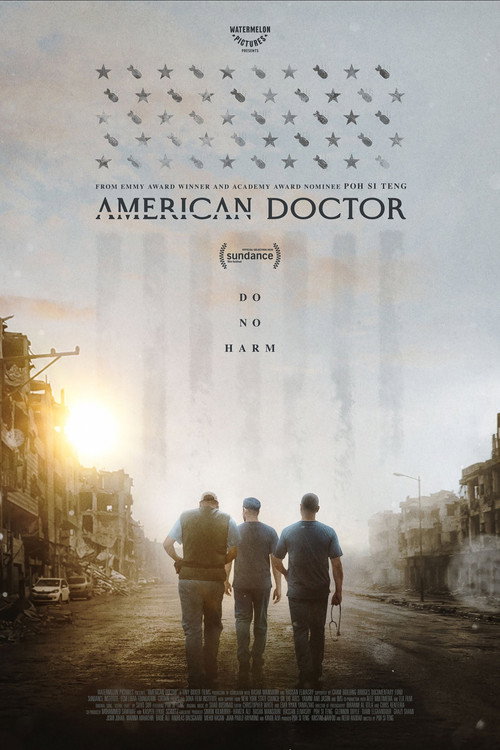
American Doctor is a vérité documentary following three American physicians who volunteer to provide medical care in Gaza during the ongoing conflict. The trio — Dr. Mark Perlmutter, a Jewish American orthopedic surgeon from North Carolina; Dr. Thaer Ahmad, a Palestinian American emergency physician from Chicago; and Dr. Feroze Sidhwa, a Zoroastrian trauma surgeon of Pakistani Parsi heritage from California — work primarily out of Nasser Hospital in Khan Younis across two visits, before and after the January 2025 ceasefire. Before entering Gaza, the group must navigate bureaucratic obstacles to secure Israeli entry permits; Dr. Ahmad faces particular difficulty due to his Palestinian heritage, despite holding the same American credentials as his colleagues. Upon arrival, they find a landscape of widespread destruction — twisted metal and rubble replacing most infrastructure — and begin working in hospital operating rooms and corridors under severe resource scarcity, lacking adequate equipment and facilities. The film opens with a charged moment in which Dr. Perlmutter demands that director Poh Si Teng show an unblurred photograph of babies killed in a missile strike, arguing that obscuring the images hides the reality of events; this sets the documentary's unflinching, graphic tone. The doctors treat patients and witness a population emotionally numbed by relentless attacks with no apparent end. On August 25, 2025, during an announced ceasefire, Nasser Hospital is bombed by Israel, killing 22 people including five journalists. After returning to the United States, the film tracks the doctors through media appearances and political advocacy: Dr. Perlmutter authors an opinion piece characterizing Israel's actions as genocide, and both Perlmutter and Ahmad travel to Washington, D.C., to lobby policymakers. The advocacy draws a severe backlash, including death threats against some of the doctors. The documentary moves between the harrowing frontline medical work in Gaza and the political battles fought on American soil, framing the doctors' experiences as an attempt to force the reality of the conflict into public consciousness.
Sources: Wikipedia, Film Threat review, Web search (IMDb metadata, Sundance listing, Deadline, Variety, Hollywood Reporter headlines)