Movie
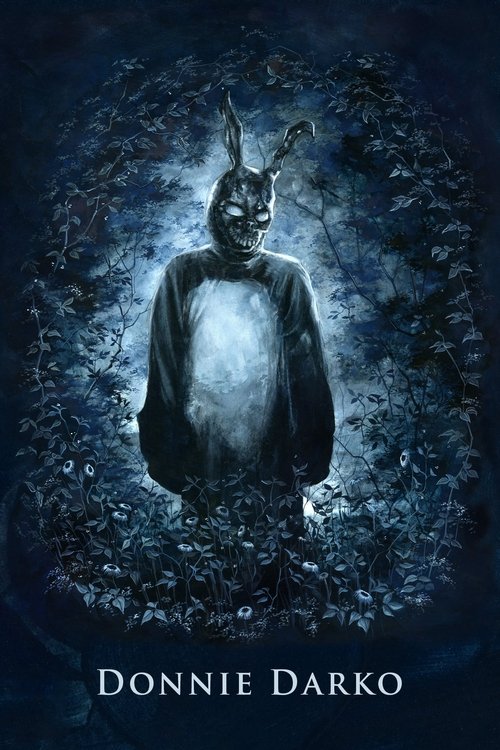
Donnie Darko
Narrative tropes
One Hero Changes Everything
mediumThe world-ending crisis — tangent universe collapse — can only be resolved by Donnie; no institution or collective has any role in the solution. The psychiatrist, school, and community remain entirely passive and oblivious. Donnie's individual sacrifice is the sole decisive act: he drives to the ridge, watches his mother's plane enter the vortex, and lies down to die. Every other character is helpless without this one person completing his specific role, and they remain unaware of how close the world came to ending.
About this trope: One exceptional individual matters more than institutions or collective action. Problems affecting millions are solved by a single remarkable person. Everyone else is passive.
Cultural messages
Science vs. Faith
highDr. Thurman's rational diagnosis of paranoid schizophrenia is the story's scientific pole; Donnie's visions, Frank, and the tangent-universe mechanics are the mystical pole. The psychiatrist's skepticism is proven categorically wrong — Frank was real. The Philosophy of Time Travel (a quasi-mystical text) outperforms clinical therapy. Science is portrayed as unable to grasp the actual situation. The climax requires Donnie to take a literal leap of faith: accepting death on the basis of visions adults dismissed.
About this message: Characters face a choice between rational/scientific thinking and spiritual/intuitive belief. The story typically validates faith or emotion over cold logic — the scientist is wrong, the believer is vindicated.
The System Is Rigged
highThree institutions that should be trustworthy are each exposed as corrupt or incompetent: the school pushes a hollow motivational curriculum Donnie correctly identifies as empty; the therapist misdiagnoses real supernatural experience as mental illness; Jim Cunningham, a community-celebrated moral authority, is concealing child pornography. Donnie achieves the only meaningful justice — Cunningham's arrest — by operating entirely outside institutional channels (arson). Working within the system (therapy, school) produces nothing useful.
About this message: Institutions meant to protect people — governments, corporations, law enforcement, the justice system — are depicted as corrupt, incompetent, or actively harmful. Heroes must work outside official channels.
Power Means Duty
mediumDonnie occupies the role of 'Living Receiver' as defined by The Philosophy of Time Travel, an extraordinary status that carries a specific obligation: he must return the artifact (the jet engine) through the portal or the tangent universe collapses. His entire 28-day arc is an unknowing preparation for this duty. He ultimately sacrifices his life and his relationship with Gretchen to fulfill it — personal happiness surrendered for a cosmic greater good. The Philosophy of Time Travel explicitly frames the Receiver's power as inseparable from the duty to sacrifice.
About this message: Those gifted with extraordinary abilities, wealth, or status have a moral obligation to use them for others — and the weight of that duty can be crushing. Privilege creates obligation.
Movies that share these tropes


Full plot (spoilers)
On October 2, 1988, in a Virginia suburb, troubled teenager Donnie Darko sleepwalks outside, drawn by a mysterious voice, and encounters a figure in a monstrous rabbit costume named Frank. Frank warns him the world will end in 28 days, 6 hours, 42 minutes, and 12 seconds. Donnie wakes the next morning on a golf course to find a jet engine of unknown origin has crashed into his bedroom. His psychotherapist, Dr. Thurman, diagnoses him with paranoid schizophrenia, attributing his visions of Frank to 'daylight hallucinations.' Frank repeatedly influences Donnie's sleepwalking, leading him to flood the high school by breaking a water main. Donnie starts dating Gretchen Ross, a new girl who relocated with her mother under a false identity to escape her violent stepfather. Donnie grows obsessed with The Philosophy of Time Travel, a book written by Roberta Sparrow, a reclusive former science teacher known to local teens as 'Grandma Death.' He rebels against the school's motivational-speaker curriculum pushed by gym teacher Kitty Farmer, eventually burning down the home of charismatic self-help guru Jim Cunningham after Frank directs him to — a fire that exposes Cunningham's secret cache of child pornography and leads to his arrest. On Halloween night, with his parents away, Donnie and his sister Elizabeth throw a party. Gretchen arrives distressed because her mother has vanished; she and Donnie have sex for the first time. As the deadline Frank foretold approaches, Donnie takes Gretchen and friends to find Sparrow. At her house they encounter two bullies robbing the place; a brawl spills into the road just as Sparrow returns, and an oncoming car runs over and kills Gretchen. The driver is Frank Anderson — Elizabeth's boyfriend wearing the same rabbit costume — and Donnie, in grief and fury, shoots him in the right eye. Donnie carries Gretchen's body home. At dawn, a massive vortex forms above his house. Donnie drives to a ridge overlooking the town and watches as the plane returning his mother and a dance troupe from Los Angeles is caught in the vortex, which tears off an engine and hurls it back through time. The previous 28 days unwind: Donnie wakes on October 2nd, laughs as he recognizes the date, and lies still while the returned jet engine crashes into his room and kills him. Around town, the people whose lives he touched wake from uneasy dreams. The next day Gretchen — who has no memory of Donnie — rides past the Darko house, learns of his death, and shares a wordless wave of inexplicable recognition with Donnie's grieving mother.
Sources: Wikipedia