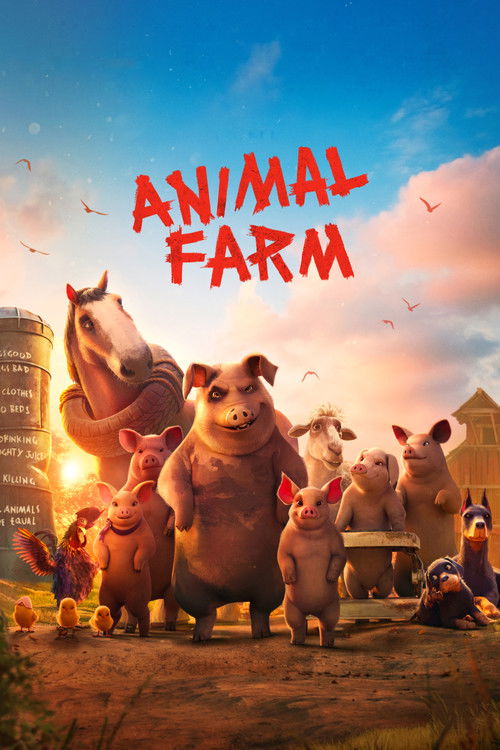
Movie
Animal Farm
Narrative tropes
Good Intentions, Terrible Results
highThe revolution starts with a genuinely sympathetic cause — animals exploited by Mr. Jones — and a morally coherent founding principle. Napoleon's subsequent tyranny is continuously rationalized by Squealer, whose propaganda represents exactly the 'internally consistent but morally horrifying' logic signal. The commandments are rewritten to justify each abuse as necessary. The horror of the story — that the liberators became indistinguishable from the oppressors — is the definitive 'good intentions, terrible results' payload.
About this trope: A villain — or sometimes a hero — genuinely believes they are doing the right thing, but their well-meaning plan leads to monstrous outcomes. The scariest antagonists think they're saving the world.
You Can't Trust Anyone
highThe pigs — who led and embodied the revolution — are the hidden enemy, satisfying 'the true enemy was hiding in plain sight among allies.' The commandments are secretly rewritten; history is covertly erased. Lucky's arc is specifically the discovery that he has been manipulated by Napoleon's 'seductive promises of belonging and protection.' The institution Lucky was raised to trust (Animal Farm's founding order) is revealed as thoroughly compromised from within.
About this trope: Trusted allies, institutions, or authority figures are secretly working against the protagonist. Paranoia is justified because betrayal is real and pervasive.
Kids See the Truth
highLucky is explicitly a young, impressionable piglet who is taught to question authority and becomes the film's 'moral fulcrum.' His youthful clarity allows him to perceive the pigs' corruption while adult animals like Boxer continue in blind, enabling faith. Adults are portrayed as too compromised or conditioned to see the truth. Lucky's innocence is the story's primary vehicle for moral perception — a direct match to 'innocence depicted as a form of wisdom, not naivety.'
About this trope: Children possess intuitive wisdom, moral clarity, or a connection to truth that cynical adults have lost. Kids see through lies, sense danger, and understand what really matters.
Cultural messages
Power Always Corrupts
highNapoleon begins as a revolutionary liberator but steadily consolidates power and becomes tyrannical — a textbook corruption arc. Squealer actively rationalizes each new abuse (rewriting commandments, erasing history), satisfying the 'rationalizes increasingly extreme actions' signal. Lucky witnesses the change firsthand. The founding ideal ('all animals are equal') is an object of power that Napoleon's regime corrupts and ultimately inverts. Lucky's final embrace of collective solidarity over hierarchy frames the destruction of that power structure as liberation.
About this message: Gaining power — political, magical, technological, or financial — inevitably warps even the noblest people. Power is an inherently corrupting force.
Movies that share these tropes
Full plot (spoilers)
Animal Farm (2026) is an animated adaptation of George Orwell's 1945 novella, directed by Andy Serkis, that reimagines the allegory as a coming-of-age story centered on a new protagonist, Lucky, a young and impressionable piglet (voiced by Gaten Matarazzo). The film opens on a farm where the animals, long neglected and exploited by their human owner Mr. Jones, are inspired to revolt and seize control of the property, renaming it Animal Farm. They establish a founding principle — 'all animals are equal' — and build a community based on shared labor and mutual respect. Lucky is raised within this new order and is taught to read, to question authority, and to imagine a fairer world. However, the charismatic and calculating pig Napoleon (Seth Rogen) steadily consolidates power, ousting his rival Snowball and positioning himself as the farm's unchallenged leader. Napoleon's lieutenant Squealer (Kieran Culkin) functions as a propaganda mouthpiece, rewriting history and manipulating language to justify each new abuse of authority. The loyal workhorse Boxer (Woody Harrelson) continues toiling in blind faith, embodying the rank-and-file animals who enable the regime. Lucky, caught between Napoleon's seductive promises of belonging and protection and his growing awareness of the pigs' corruption, becomes the film's moral fulcrum. As the pigs gradually adopt human mannerisms — walking upright, carrying whips, fraternizing with neighboring farmers — the founding commandments are quietly altered until the familiar maxim reads: 'all animals are equal, but some animals are more equal than others.' Lucky ultimately undergoes an awakening, recognizing that the pigs have become indistinguishable from the human oppressors the animals originally overthrew. His arc ends with an implied embrace of collective solidarity over hierarchical power. Unlike Orwell's novella, the film strips away explicit parallels to Stalin and the Soviet Union, recasting the allegory as a broader critique of 21st-century business corruption and authoritarian populism. The adaptation carries a PG rating, runs 74 minutes, and employs a lush, warmly animated visual style that softens the story's inherent brutality while still conveying its satirical thrust. Note: the film releases May 1, 2026 and had not yet opened at time of research; plot details derive from pre-release reviews and official promotional materials.
Sources: Wikipedia (Animal Farm 2025 film article), IMDb (tt2467700), Angel Studios official website, Hyphen (pre-release review, April 24 2026), People's World (pre-release review)