Movie
Hanging by a Wire
Narrative tropes
Humans Never Give Up
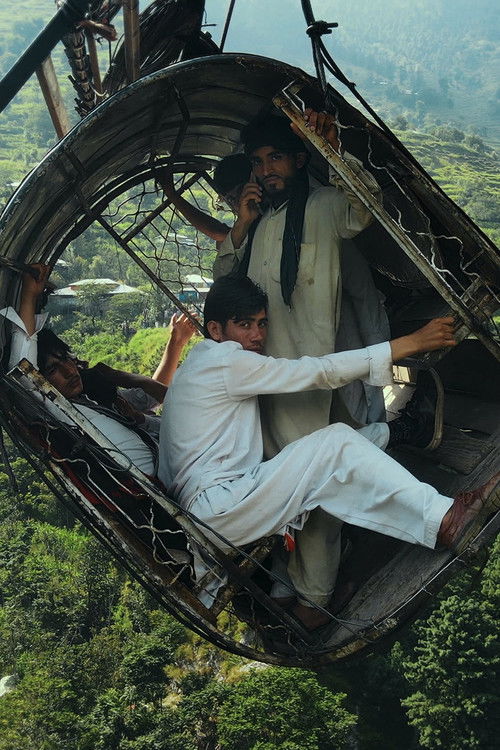
highEight people are stranded 900 feet above a ravine with the last cable expected to fail within hours — objectively hopeless circumstances. Rescuers persist through multiple failed technique attempts, deteriorating visibility, and nightfall. The film frames the refusal to quit as heroic: community members keep improvising when conventional methods fail, hope outlasting rational expectation, and the emotional weight rests on the sustained effort rather than just the successful outcome.
About this trope: Facing impossible odds, humans endure, adapt, and find reasons to keep going. Resilience and refusal to surrender is humanity's defining and most admirable trait.
Cultural messages
Humanity Must Unite
highShahib Khan (local community member) and Ali Swati (army-deployed bodybuilder/zipliner) come from very different backgrounds and are explicitly driven partly by competitive desires for recognition — they are divided figures who must nonetheless cooperate. No single approach or party can solve the rescue alone; an array of techniques and ultimately ordinary community members from across the assembled crowd prove collectively decisive. Victory is structurally impossible without cross-group collaboration.
About this message: A shared external threat forces divided groups to set aside differences and cooperate. Unity across lines of division is both necessary for survival and morally uplifting.
The System Is Rigged
mediumThe documentary explicitly frames the cable car's dangerous condition as a product of government inattention and poverty — the institution responsible for rural infrastructure has been willfully negligent. Conventional (official) rescue methods prove insufficient. It is outside-the-system actors — unexpected community problem solvers — who ultimately succeed. The film broadens to expose systemic neglect as the structural villain, validating action outside official channels.
About this message: Institutions meant to protect people — governments, corporations, law enforcement, the justice system — are depicted as corrupt, incompetent, or actively harmful. Heroes must work outside official channels.
The Rich Are the Problem
mediumThe film explicitly broadens to address class divisions that complicated the rescue and the systemic neglect of rural infrastructure driven by poverty and government inattention. The cable car's lethal condition is a direct consequence of the state's indifference to poor rural communities. Ordinary community members (the poor) prove more effective and resourceful than the powerful institutional actors, and the documentary exposes the system's design as one that leaves the rural poor behind.
About this message: Wealthy elites are portrayed as exploitative, callous, or predatory, and extreme inequality is the central injustice driving the story.
Movies that share these tropes





Full plot (spoilers)
On the morning of August 22, 2023, eight people — six schoolboys and two adults — board a makeshift cable car for their routine commute across a mountain pass in the Allai valley of Battagram, in northwest Pakistan's remote Himalayan foothills. It is the only practical way to reach school from their village. Mid-crossing, roughly 900 feet above the ravine floor, two of the three supporting cables suddenly snap. The gondola lurches and comes to rest, swaying on a single damaged wire. The children are alive but stranded, and the compromised remaining cable is expected to fail within roughly ten hours. News of the incident spreads quickly, drawing a crowd of onlookers and bringing the crisis to the attention of regional and national authorities. Two key figures emerge in the rescue effort: Shahib Khan, a local community member with prior experience handling accidents in the area, and Ali Swati, a bodybuilder and zipliner brought in by the national army. Though they come from very different backgrounds and are driven partly by competitive desires for recognition, the two must work together under mounting pressure. An array of techniques is attempted to reach the stranded gondola, with the situation growing more dangerous as deteriorating visibility arrives with nightfall. The film documents how conventional rescue methods prove insufficient and how 'unexpected problem solvers' — ordinary community members — ultimately prove instrumental. All eight passengers are rescued safely. Director Mohammed Ali Naqvi constructs the film from drone footage, on-the-ground recordings made by the assembled crowd of onlookers, and tasteful reenactments featuring the actual participants. In the aftermath, the documentary broadens its lens to address the systemic neglect of rural infrastructure in Pakistan — the cable car's dangerously precarious condition was itself a product of poverty and government inattention — and the class divisions that complicated the rescue effort.
Sources: Web search (Deadline, Variety, Sundance programme), MoveableFest review, Silver Screen Capture review, FirstShowing.net article, TMDb overview