Movie
Henry David Thoreau
Cultural messages
Nature Knows Best
highThoreau's Walden experiment is the documentary's centerpiece: nature and wilderness are idealized through new Concord cinematography and tonally reverent framing; Thoreau gains wisdom, authenticity, and moral clarity by retreating from industrial society; industrialization is consistently framed as a spiritual and moral crisis; and modern/urban/industrial life is depicted as shallow and corrupting by contrast with natural living. 'Living in harmony with nature' is named as one of the film's core resonant themes.
About this message: The natural world, indigenous peoples, or pre-industrial life is portrayed as inherently wise, pure, morally superior, or spiritually richer than modern civilization. Nature is a source of truth that technology has replaced.
The System Is Rigged
mediumCivil Disobedience is a central focus: the US government is depicted as corrupt and complicit—supporting slavery and prosecuting an unjust war—institutions that should protect citizens fail morally, and Thoreau's entire thesis (refusing to pay taxes, accepting jail) is premised on the idea that true justice requires bypassing and resisting unjust institutional authority. His vindication is confirmed by his influence on Gandhi and King, who applied the same outside-the-system framework.
About this message: Institutions meant to protect people — governments, corporations, law enforcement, the justice system — are depicted as corrupt, incompetent, or actively harmful. Heroes must work outside official channels.
Movies that share these tropes




Full plot (spoilers)
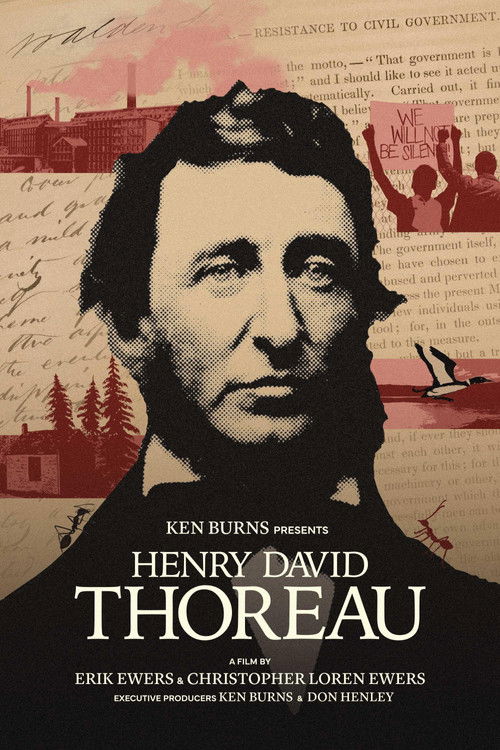
Henry David Thoreau is a three-part, three-hour PBS documentary (directed by Erik Ewers and Christopher Loren Ewers, executive produced by Ken Burns and Don Henley) that aired March 30–31, 2026. Narrated by George Clooney, with Jeff Goldblum voicing Thoreau and supporting voices from Meryl Streep, Ted Danson, and Tate Donovan, the film presents Thoreau not as a solitary hermit but as a fully engaged figure in antebellum New England whose life and ideas remain urgently relevant. The documentary traces Thoreau's life from his origins in Concord, Massachusetts through his deepening involvement with the major moral crises of his era: the expansion of industrialization, the institution of slavery, war, and early environmental degradation. It examines the foundational themes of his writing—an individual's relationship to the state, the imperative to live deliberately and authentically, humanity's connection to the natural world, and the impact of race on American society—as expressed most powerfully in Walden and Civil Disobedience. The film portrays Thoreau as brilliant but flawed, idealistic yet opinionated, challenging the romantic myth that has long obscured the complexity of his character. It also charts his lasting intellectual legacy, tracing his influence on subsequent reformers and thinkers including John Muir, Mahatma Gandhi, and Martin Luther King Jr. The documentary combines archival materials, new cinematography shot in and around Concord, and commentary from scholars, building a portrait of a writer and activist whose words resonate with contemporary debates about justice, civic responsibility, and living in harmony with nature.
Sources: Walden Woods Project (walden.org), Thoreau Society (thoreausociety.org), ASU Center for the Study of Race and Democracy (csrd.asu.edu), Web search results