Movie
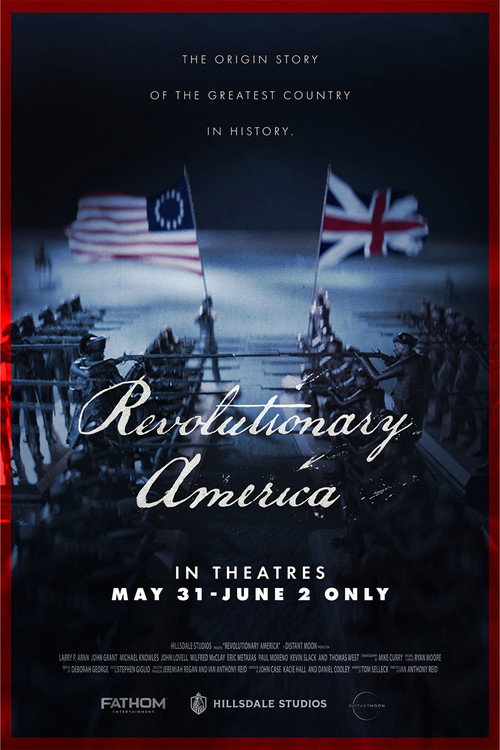
Revolutionary America
Narrative tropes
Rebels vs. The Empire
highThe film is structured entirely around the classic small-rebels-vs.-empire arc: American colonists explicitly described as outmatched against 'the most powerful empire of the age,' framed as morally righteous in their cause ('lives, fortunes, and sacred honor'), portrayed as brave against overwhelming odds, Britain cast as the oppressive authority denying the colonists' inherent right to self-rule, and independence ultimately won. All five signals fire: oppressive authority, small band against long odds, rebels depicted as brave and righteous, regime shown as illegitimate/cruel, and victory achieved despite the power gap.
About this trope: A small outmatched group rises up against a massive oppressive regime or institutional power. The rebellion is framed as morally righteous.
Humans Never Give Up
mediumThe film foregrounds resilience against hopeless odds as its emotional core: 'victory was far from certain,' success came only through 'extraordinary sacrifice and commitment to political principle,' and the colonists faced 'the most powerful empire of the age.' Three signals are present: refusal to quit when surrender would be rational, survival/victory against long odds as the central narrative arc, and hope persisting when logic said it shouldn't. The resilience of ordinary colonists and Founders alike is framed as heroic and historically defining.
About this trope: Facing impossible odds, humans endure, adapt, and find reasons to keep going. Resilience and refusal to surrender is humanity's defining and most admirable trait.
Movies that share these tropes


Full plot (spoilers)
Revolutionary America (2026) is a feature-length documentary produced by Hillsdale Studios and narrated by Tom Selleck. It traces the story of the American Founding across roughly the period 1763–1791, framing the Revolution as the greatest political achievement in human history. The film opens by establishing that American colonists had spent approximately 150 years developing a distinctive tradition of self-government in the New World, making local governance and political autonomy central to their way of life. That tradition came under direct threat after the French and Indian War, when Britain asserted that the colonists had no inherent right to rule themselves — a claim the film presents as fundamentally incompatible with everything the colonists understood about liberty and legitimate authority. Faced with this challenge, colonial leaders and ordinary citizens alike concluded that resistance was necessary. The documentary chronicles how Americans risked their lives, fortunes, and sacred honor to wage the War for Independence against the most powerful empire of the age. It emphasizes that victory was far from certain and came only through extraordinary sacrifice and commitment to political principle. The film concludes by examining how, having won independence against long odds, the Founders channeled their hard-won experience into building a stable and lasting republic — the constitutional order that endures to the present. Throughout, the narrative is carried by expert commentary from Hillsdale College President Larry P. Arnn and faculty scholars (John Grant, Wilfred McClay, Paul Moreno, Kevin Slack, Thomas West), as well as public commentators including Michael J. Knowles, John Lovell, and Eric Metaxas, combined with primary source documents, evocative historical artwork, dynamic visual effects, and an original musical score.
Sources: Fathom Entertainment release page, Moviefone, Web search (Hillsdale College / IMDb metadata)