Movie
Everybody to Kenmure Street
Narrative tropes
Rebels vs. The Empire
highAll core elements present: (1) stark power imbalance — 2,500 ordinary residents vs. UK Home Office enforcement; (2) resistance framed as entirely sympathetic throughout; (3) meaningful victory — both detainees unconditionally released. All five signals hit: the government authority conducts immigration raids on Eid al-Fitr (dehumanizing/oppressive framing); a small spontaneous group organises against a state apparatus; the crowd is portrayed as brave and morally righteous (Sundance jury, film's tone); the regime is shown as cruel by its own actions; and victory is achieved despite the obvious power gap via sustained civil disobedience and legal negotiation.
About this trope: A small outmatched group rises up against a massive oppressive regime or institutional power. The rebellion is framed as morally righteous.
Humans Never Give Up
mediumCore pattern met: ordinary residents face an objectively daunting circumstance (government enforcement van, state authority), choose to sustain the blockade for eight hours rather than disperse, and the film frames that perseverance as the heroic and defining act. Signals: the activist who crawled under the van refused to quit when surrender was the rational choice; maintaining 2,500 people in a sustained eight-hour blockade against the state represents survival against long odds; and hope persists throughout despite no guarantee of release. The emotional weight of the film centres on the sustained decision to remain, not only on the eventual outcome.
About this trope: Facing impossible odds, humans endure, adapt, and find reasons to keep going. Resilience and refusal to surrender is humanity's defining and most admirable trait.
Cultural messages
Humanity Must Unite
mediumCore pattern largely satisfied: the protest draws together strangers across ethnic and social lines in one of Scotland's most diverse neighbourhoods — not prior rivals but genuinely unconnected groups — around a shared external threat no individual could counter alone. Cooperation is the explicit mechanism of release. Signals: the rallying cry 'Everybody to Kenmure Street' functions as the unity speech; victory is impossible without the critical mass of 2,500 people; the shared threat (state enforcement) eclipses any internal differences; and diverse strangers take on coordinated roles spontaneously. The 'former enemies' signal is absent, keeping the count at 3.
About this message: A shared external threat forces divided groups to set aside differences and cooperate. Unity across lines of division is both necessary for survival and morally uplifting.
Movies that share these tropes






Full plot (spoilers)
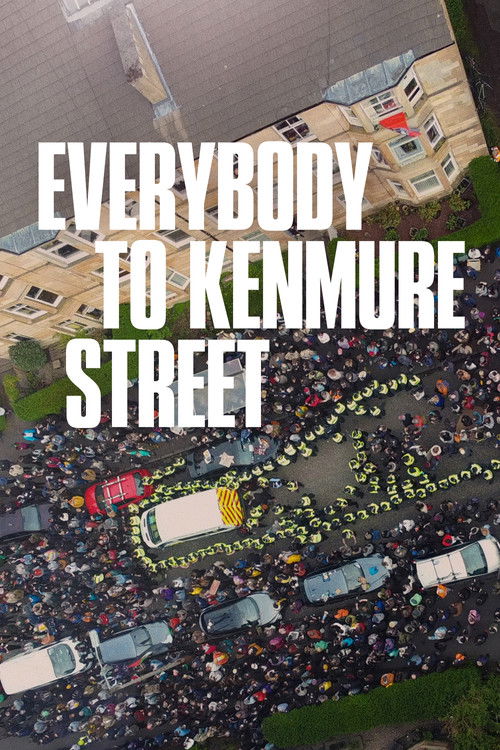
Everybody to Kenmure Street is a 2026 documentary directed by Felipe Bustos Sierra that reconstructs a real act of community civil resistance in Glasgow, Scotland. On the morning of May 13, 2021 — Eid al-Fitr — UK Home Office immigration enforcement officers arrived on Kenmure Street in Pollokshields, one of Scotland's most ethnically diverse neighbourhoods, and detained two men of Indian origin for alleged immigration violations, placing them in a government van. Word spread rapidly through local activist networks under the message 'Everybody to Kenmure Street,' prompting residents to abandon their breakfast tables, work calls, and daily routines and rush to the scene. One activist crawled beneath the van and secured himself to the axle, an act of civil disobedience (voiced in the film by Emma Thompson) that became central to the protest. What began as a small group surrounding the vehicle grew over the course of eight hours into an estimated crowd of 2,500 people — largely strangers to one another — who organised themselves spontaneously, taking on essential roles to sustain the blockade. The crowd prevented the van from departing. Human rights lawyer Aamer Anwar ultimately negotiated the unconditional release of the two detainees. The film constructs its account chronologically from a vast archive of crowd-sourced footage (around 2,000 bystanders had their phones out), archival material, and dramatised sequences, frequently employing split-screen to show the same moments from multiple vantage points. Woven into the immediate narrative is broader context about Glasgow's political history and traditions of collective solidarity, framing the Kenmure Street event as an expression of deeply rooted community values. The film premiered at the 2026 Sundance Film Festival, where it won the Special Jury Award for Civil Resistance.
Sources: Wikipedia, IndieWire, WebSearch (aggregated: IMDb, Sundance, Deadline, FirstShowing, Letterboxd listings)