Movie
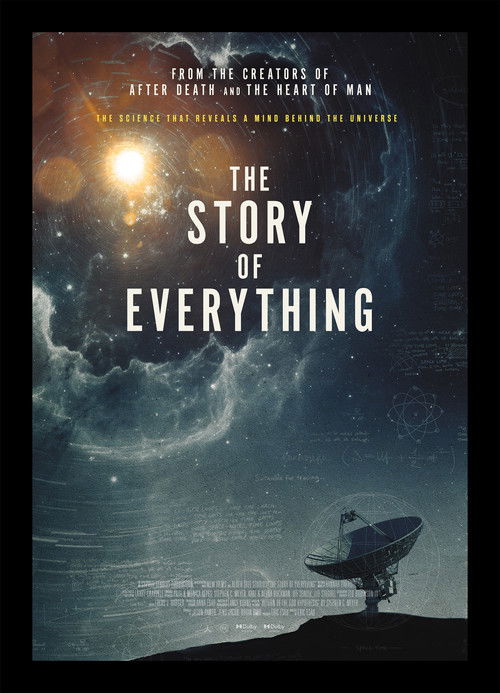
The Story of Everything
Cultural messages
Science vs. Faith
mediumThe film is structured as a direct engagement with the science-vs-faith tension: it marshals cosmology, fine-tuning physics, and molecular biology to argue that purely naturalistic explanations are insufficient, then validates an explicitly Christian theistic worldview as the rational conclusion. Scientific naturalism (the implicit opposing position) is portrayed as limited and unable to account for the origin of the universe, physical constants, or DNA complexity. The film's climactic thesis — Meyer's 'look designed because they are designed' — is an explicit faith statement, and the framing device quoting Cicero positions spiritual intuition as prior to and confirmatory of scientific inquiry.
About this message: Characters face a choice between rational/scientific thinking and spiritual/intuitive belief. The story typically validates faith or emotion over cold logic — the scientist is wrong, the believer is vindicated.
Movies that share these tropes

Full plot (spoilers)
The Story of Everything is a feature-length documentary that constructs a cumulative case for intelligent design across three interlocking lines of scientific and philosophical argument. The film opens with a classical framing device, quoting Roman philosopher Cicero's observation that the beauty of the cosmos points toward an 'excellent and eternal Being.' From there, philosopher of science Stephen C. Meyer leads an ensemble of 24 scientists, engineers, and philosophers through three broad movements. First, the film addresses the origin of the universe itself, arguing that because the cosmos had a definite beginning it requires an external, intelligent cause rather than a purely naturalistic explanation. Second, it examines the fine-tuning of physical constants and laws—the precise values that allow stars, planets, and life to exist—contending that even multiverse hypotheses ultimately presuppose some form of prior design. Third, the documentary turns to molecular biology, analyzing the complexity of the living cell and the information-dense structure of DNA to argue that such intricate systems cannot plausibly arise through undirected natural processes alone. Meyer summarizes the film's thesis directly: the many components of the cell 'look designed because they are designed.' The film is beautifully shot and interweaves imagery of distant star-forming nebulae and DNA's double helix to reinforce its central claim that a consistent signature of intentional creation is woven into nature at every scale. Contributors include Oxford mathematician John Lennox and executive producer Lee Strobel. The film presents an explicitly Christian theistic worldview and is described as spiritually edifying family-appropriate content. No traditional dramatic narrative is present; the arc is entirely argumentative and expository. The film releases April 30, 2026, and this summary is drawn from pre-release promotional and review materials only.
Sources: Movieguide, Fathom Entertainment, AllMovie, TMDb overview (provided), IMDB (no plot data returned)