Movie
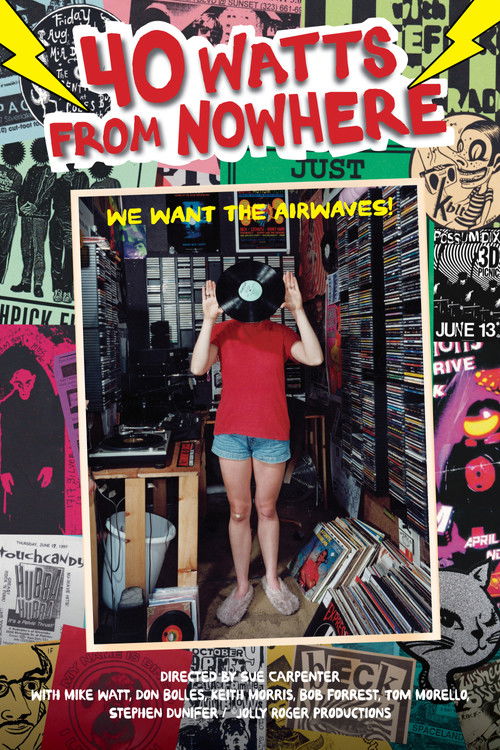
40 Watts from Nowhere
Narrative tropes
Rebels vs. The Empire
highKBLT is a 40-watt closet transmitter vs. the FCC and consolidated corporate FM — a textbook asymmetric power struggle. The documentary frames Carpenter and the pirate radio community as morally righteous underdogs; the FCC/corporate system is portrayed as homogenizing and oppressive. The regime is shown as cruel (federal shutdown, $11K fine, and the 2000 law that specifically barred former pirates from LPFM licenses to punish the movement's pioneers). Meaningful resistance is achieved: KBLT ran three years, attracted punk legends and the Red Hot Chili Peppers, and its movement directly seeded the LPFM cause — all five rebel-vs-empire signals are present.
About this trope: A small outmatched group rises up against a massive oppressive regime or institutional power. The rebellion is framed as morally righteous.
Big Brother Is Watching
highThe FCC's spectrum-monitoring apparatus is the surveillance mechanism: Carpenter operated under the assumed name 'Paige Jarrett' specifically to evade detection, framing the entire operation as life under a watchful regulatory eye. Federal agents ultimately tracked KBLT down and forced a shutdown. The film implicitly stages a security-vs-freedom debate — FCC licensing regime vs. the public's right to hear diverse voices — and the protagonist's only path to broadcasting freely was to go off-grid and anonymous. Four of five signals are solidly present.
About this trope: Surveillance technology is used by those in power to control, manipulate, or oppress people. The story presents a tension between security and freedom, concluding that surveillance is more dangerous than the threats it claims to prevent.
Cultural messages
The System Is Rigged
mediumThe FCC, nominally a public-interest institution, is depicted as an enforcer for consolidated corporate broadcasting rather than community voices. No legal low-power FM path existed, forcing Carpenter entirely outside institutional rules to broadcast. The 2000 Radio Broadcast Preservation Act — which specifically excluded the movement's pioneers from the LPFM licenses their activism created — is the clearest 'system rigged against the protagonist' beat: working within the system not only failed but was weaponized against them.
About this message: Institutions meant to protect people — governments, corporations, law enforcement, the justice system — are depicted as corrupt, incompetent, or actively harmful. Heroes must work outside official channels.
Movies that share these tropes




Full plot (spoilers)
40 Watts from Nowhere is a 2025 documentary about Sue Carpenter, a legal secretary in her late twenties living in Silver Lake, Los Angeles, who grew so frustrated with the homogenized landscape of commercial FM radio in the mid-1990s that she decided to build her own station from scratch. In 1995, working under the assumed name 'Paige Jarrett' to evade FCC detection, she constructed a 40-watt FM transmitter and began broadcasting from a closet in her small apartment — naming the station KBLT. With no formal broadcasting experience, Carpenter ran KBLT 24 hours a day, rotating a different DJ through every two hours. She recruited talent entirely from the underground and alternative music community: punk veterans Keith Morris (Circle Jerks), Don Bolles (Germs), and Mike Watt (Minutemen) all took shifts, as did ordinary music obsessives who shared the station's ethos of playing whatever they loved — jungle, punk, vintage country, French pop — without corporate gatekeeping. Word spread through word of mouth, and the station achieved a kind of pre-internet virality. High-profile musicians sought it out; the Red Hot Chili Peppers performed live in Carpenter's living room during a broadcast, and Mazzy Star headlined a benefit concert for the station. KBLT was operating within a broader national phenomenon: a legal loophole had allowed hundreds of low-power unlicensed operators to proliferate across the country, and pirate radio activists like Stephen Dunifer of Free Radio Berkeley had turned the movement into a political cause, laying the groundwork for what would eventually become the legal Low Power FM (LPFM) movement. At its peak in the summer of 1998, Carpenter expanded coverage by installing a relay transmitter atop a Hollywood skyscraper, extending KBLT's signal all the way to LAX. The FCC soon took notice. Later in 1998 federal agents shut down the station and presented Carpenter with an ultimatum: hand over all equipment or pay an $11,000 fine. The documentary then traces the aftermath: the 2000 Radio Broadcast Preservation Act specifically barred former pirate operators from obtaining newly created LPFM licenses, closing the door on the movement's pioneers. The film's archival backbone is 12 hours of mini-DV footage shot by one of KBLT's DJs in 1998, capturing the station's heyday through its shutdown; Carpenter discovered the tapes in early 2023 and built the documentary around them. Contemporary talking-head interviews — with Tom Morello (Rage Against the Machine), Mike Watt, Keith Morris, Don Bolles, and Stephen Dunifer — frame the archival material and reflect on what KBLT meant as a cultural and political act. Executive producer Jack Black described KBLT as 'the best goddamn music you could hear on the FM dial.' The film premiered at the Slamdance Film Festival on February 22, 2025.
Sources: Web search synthesis across multiple outlets: Park Record, RabbleRouse News, InsideAudioMarketing.com / InsideRadio, TheCreativeImbalance.com, SF DocFest / Roxie Theater program notes, Slamdance Channel