Movie
Gaslit
Narrative tropes
Rebels vs. The Empire
highThe power imbalance is explicit: U.S. oil and gas megacorporations versus scattered Gulf Coast and West Texas communities. Frontline residents — 'reluctant activists' spanning the political spectrum — are portrayed as brave and morally righteous underdogs. The industry is depicted as cruel and dehumanizing (forced land sales, contaminated water, invisible methane plumes). The film's call to action, Fonda's pledge to fight 'until the day I die,' and its festival recognition frame the resistance as meaningful challenge against overwhelming institutional power.
About this trope: A small outmatched group rises up against a massive oppressive regime or institutional power. The rebellion is framed as morally righteous.
Cultural messages
The Rich Are the Problem
highFossil fuel corporations are portrayed as having 'profited enormously while knowingly harming communities' — the archetypal exploitative wealthy antagonist. The film visually and narratively contrasts corporate gain with devastated frontline communities (shrimpers, ranchers, former workers). Community members are consistently framed as more moral and sympathetic. The 'Polluter Pays Pact' framing explicitly argues the economic system is designed to protect corporate profits at community expense. Accountability and exposure of the powerful serve as the resolution.
About this message: Wealthy elites are portrayed as exploitative, callous, or predatory, and extreme inequality is the central injustice driving the story.
The System Is Rigged
mediumThe film's title and central metaphor — 'gaslighting' — directly implies that official/regulatory institutions have been complicit in concealing harm. Decades of unchecked expansion despite documented community damage signals willful regulatory negligence. The call for a new 'Polluter Pays Pact' argues the existing legal framework systematically fails to hold polluters accountable. Justice is sought outside official channels through documentary filmmaking, community organizing, and celebrity advocacy rather than through regulatory or legal institutions.
About this message: Institutions meant to protect people — governments, corporations, law enforcement, the justice system — are depicted as corrupt, incompetent, or actively harmful. Heroes must work outside official channels.
Movies that share these tropes




Full plot (spoilers)
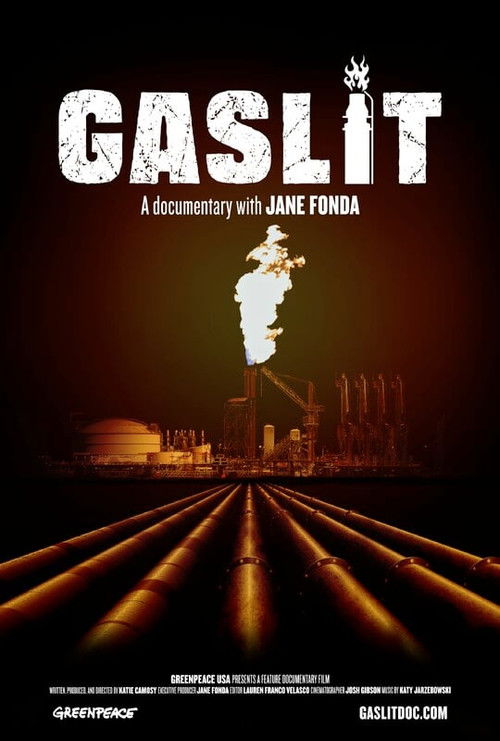
Gaslit (2026) is a feature documentary directed by Katie Camosy and produced by Greenpeace USA in which actor and activist Jane Fonda embarks on a road trip through Texas oil fields and Gulf Coast communities in Texas and Louisiana. The film chronicles the decades-long struggle between fossil fuel corporate interests and the everyday people whose lives, livelihoods, and landscapes have been damaged by the U.S. oil and gas extraction boom — a boom that has made the United States the world's largest exporter of liquefied natural gas (LNG) and is simultaneously driving a massive expansion of plastics production as fossil fuel companies pivot to petrochemicals. Along the way, Fonda joins two self-described 'methane hunters' in West Texas, using an optical gas imaging camera to render otherwise invisible emissions visible; she is visibly shaken by the large methane plumes she witnesses, declaring 'Massive clouds of methane coming through… I'm so angry.' She meets a cattle rancher who was forced to sell land his family had held for generations after nearby extraction operations allegedly contaminated its water. The documentary weaves together intimate portraits of a diverse array of frontline residents — shrimpers, ranchers, former oil workers, faith community members, family members, community organizers, and self-described 'reluctant activists' — who span the political and cultural spectrum yet have come together in common cause to defend their communities and coastlines. Actress Connie Britton and Grammy-nominated musician Maggie Rogers also accompany Fonda on portions of the journey, amplifying the film's call to action. Fonda pledges to the residents she meets: 'I will do everything in my power until the day I die to make sure people know what's going on here.' The film frames corporate fossil fuel expansion as a form of environmental and social gaslighting — an industry that has profited enormously while knowingly harming communities — and advocates for a 'Polluter Pays Pact' as a path toward accountability. Gaslit premiered on February 5, 2026, at the Santa Barbara International Film Festival, where it won Best Documentary.
Sources: gaslitdoc.com (official site), Greenpeace USA press release, Deadline, IMDb (search result metadata)