Movie
Chronovisor
Cultural messages
The System Is Rigged
highThe Vatican functions as the ostensibly trustworthy institution that secretly suppressed the Chronovisor, creating the 'institutional silences' Béatrice encounters. She investigates entirely outside official channels — through archives, old videotapes, and scholarly texts — because working within the system yields nothing. The suppression constitutes a cover-up within an official body, authority figures are shown as willfully negligent toward inconvenient knowledge, and the film frames true understanding as only reachable by operating outside institutional rules.
About this message: Institutions meant to protect people — governments, corporations, law enforcement, the justice system — are depicted as corrupt, incompetent, or actively harmful. Heroes must work outside official channels.
Science vs. Faith
mediumBéatrice is explicitly a neuroscientist and philosopher — a figure of rational inquiry — who becomes 'obsessively drawn' to an occult, ecclesiastically-tinged legend. The film blurs 'the boundary between documented history, ecclesiastical conspiracy, and paranormal possibility,' and its central thesis — that the desire to witness the past 'can seduce even the most rigorous scholarly mind' — frames rationalism as vulnerable to mystical pull. The Borges/Eco lineage the film claims further signals that mystery and the irrational are validated over clean scientific resolution.
About this message: Characters face a choice between rational/scientific thinking and spiritual/intuitive belief. The story typically validates faith or emotion over cold logic — the scientist is wrong, the believer is vindicated.
Movies that share these tropes





Full plot (spoilers)
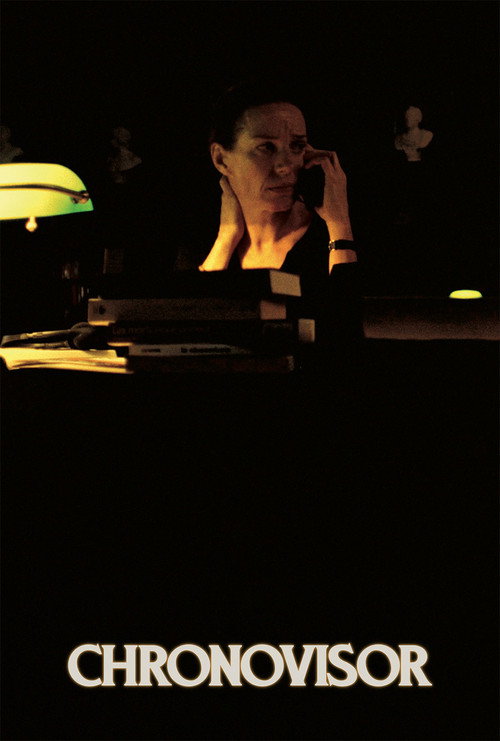
Béatrice Courte, a French academic working in New York as a philosopher and neuroscientist studying theories of memory, becomes obsessively drawn to a strange historical legend: the Chronovisor, a mysterious machine allegedly constructed in secret by Benedictine monks — primarily the Italian cleric Pellegrino Ernetti — sometime in the 1950s. The device was purported to capture and replay any visual moment in human history on a television screen, functioning as a kind of occult camera aimed at the past. The story that seizes Béatrice centers on Ernetti's extraordinary claim that he and a circle of collaborators used the Chronovisor to witness the crucifixion of Christ and to record lost ancient theatrical performances. The alleged existence of the machine caused alarm within the Vatican, which reportedly moved to suppress it. Béatrice pursues her investigation through archives, old videotapes, and scholarly texts, her research spiraling into a Borgesian labyrinth of textual clues and institutional silences. The film adopts the visual grammar and mood of 1970s noir, blurring the boundary between documented history, ecclesiastical conspiracy, and paranormal possibility. Her quest becomes an examination of how the desire to witness the past — to make history visible — can seduce even the most rigorous scholarly mind, and how institutions suppress inconvenient knowledge. The film presents itself as an armchair mystery in the lineage of Borges and Umberto Eco. Specific third-act plot developments and resolution are not available in pre-release sources; the film was not yet released at time of research.
Sources: Wikipedia, Visions du Réel, Letterboxd, IFFR, Web search (IndieWire, Grasshopper Film press)