Movie
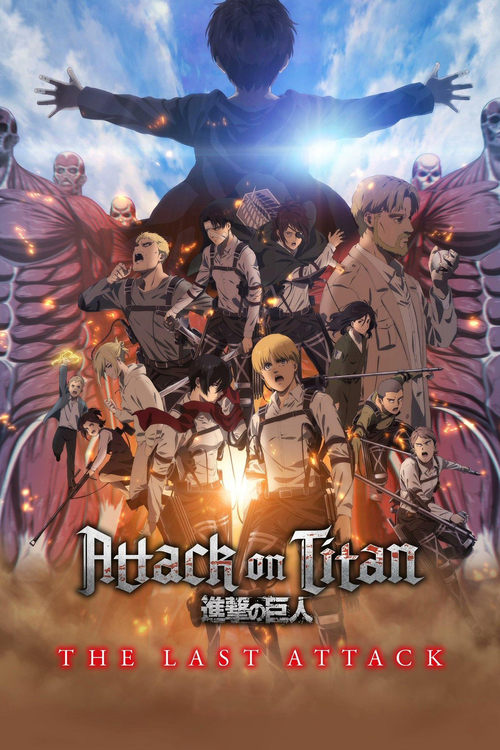
Attack on Titan: THE LAST ATTACK
Narrative tropes
Good Intentions, Terrible Results
highEren's goal — eliminating all outside threats to Paradis — is internally coherent and sympathetic given the Eldians' history of persecution. His plan (the Rumbling) would technically succeed. The story shows his certainty of being right is exactly what makes him monstrous. All five signals fire: his logic is understandable, the plan demands mass atrocity as a 'necessary' sacrifice, the alliance explicitly debates ends vs. means, Eren himself accepts responsibility rather than denying the horror, and the heroes are forced to kill someone who believes he is saving his people.
About this trope: A villain — or sometimes a hero — genuinely believes they are doing the right thing, but their well-meaning plan leads to monstrous outcomes. The scariest antagonists think they're saving the world.
Humans Never Give Up
mediumThe alliance is objectively outmatched — a small band against millions of colossal Titans marching across the earth. Surrender or retreat would be rational. They choose to fight anyway. Hope persists when logic says it shouldn't, the decision to keep fighting in the face of impossible odds is the story's moral core, and the emotional climax is that act of refusal rather than the victory itself.
About this trope: Facing impossible odds, humans endure, adapt, and find reasons to keep going. Resilience and refusal to surrender is humanity's defining and most admirable trait.
Violence Gets Results
mediumThe Rumbling is not stopped by negotiation or diplomacy — the Paths conversation with Eren does not halt the march of the Wall Titans. The plot is resolved when Mikasa severs Eren's head in direct physical combat. The climax is a battle, the decisive act is lethal force, and victory is achieved by physically defeating the antagonist. The story interrogates this emotionally but does not offer a non-violent alternative that works.
About this trope: The central conflict is ultimately resolved through physical force rather than negotiation, diplomacy, or systemic change. Talking fails; fighting works.
Born Special
mediumEren's access to the Founding Titan — the power to command all Titans and trigger the Rumbling — is entirely a function of his birth into the right bloodline (Eldian royal lineage). Mikasa's decisive combat ability is likewise rooted in her Ackerman heritage. No amount of training grants other characters these capacities. Parentage and ancestry are the source of the plot's decisive powers.
About this trope: Certain characters are inherently special by birth, blood, genetics, or prophecy — not through effort or choice. Greatness is innate, not earned.
Love Conquers All
mediumMikasa's deep bond with Eren is the reason she — and not anyone else in the alliance — delivers the killing blow. Her love motivates the decisive heroic act that ends the Rumbling and lifts the Titan curse. The epilogue and post-credits scene (Eren glad simply to be with his friends, Mikasa and Armin bickering over the ending) frame their connection as the emotional truth that outlasts all the catastrophe, suggesting love persists beyond death and cycle-of-violence.
About this trope: Love — romantic, familial, or platonic — is presented as the ultimate force that overcomes any obstacle including death, physics, evil, or cosmic forces. Love is a literal power.
Cultural messages
Humanity Must Unite
highThe entire climactic battle depends on a coalition of formerly mortal enemies — Paradisian Survey Corps soldiers and Marleyan Warriors (Reiner, Annie) — setting aside their conflict to stop the Rumbling. No single faction could survive the Wall Titans alone. Former enemies fight side by side in the climax, the shared threat dwarfs every prior grievance, and the coalition's cooperation is the literal mechanism of victory.
About this message: A shared external threat forces divided groups to set aside differences and cooperate. Unity across lines of division is both necessary for survival and morally uplifting.
Power Always Corrupts
highEren's arc is the canonical Power Always Corrupts arc: he began as an idealist wanting freedom for his people, acquired the Founding Titan (an object of near-unlimited power), and used it to plan genocide. His former comrades — every ally he ever had — now oppose him. He rationalizes mass murder as protecting Paradis. The resolution (Founding Titan's power destroyed, curse lifted) frames the removal of that power as liberation for everyone, including Eren himself.
About this message: Gaining power — political, magical, technological, or financial — inevitably warps even the noblest people. Power is an inherently corrupting force.
Movies that share these tropes


Full plot (spoilers)
Attack on Titan: THE LAST ATTACK is a 144-minute theatrical compilation film that combines the final two episodes of the Attack on Titan anime series (the concluding parts of Season 4). The story picks up with Eren Yeager having already activated the full power of the Founding Titan. He unleashes the Rumbling — an unstoppable wave of colossal Wall Titans marching across the earth — to eradicate all life outside Paradis Island, the homeland of the Eldian people. His stated goal is to eliminate any outside threat to Paradis by wiping out the rest of humanity. Faced with this act of global genocide, Eren's former comrades — including Armin Arlert, Mikasa Ackerman, and Captain Levi — refuse to condone the slaughter, even though they lack an alternative that guarantees Paradis's survival. They form an unlikely coalition with former Marleyan enemies, including Reiner Braun, Annie Leonhart, and the other surviving Warriors, to pursue and stop Eren. In a climactic final battle against Eren and his legion of Titans, the alliance fights desperately to reach him. The film features a revised version of Eren's last conversation with Armin in the mystical realm known as the Paths, where — in contrast to some earlier cuts — Eren explicitly accepts responsibility for the atrocities he has committed rather than framing the genocide as an inevitable gift to his friends. Ultimately, Mikasa strikes the killing blow and severs Eren's head, ending the Rumbling. With the Founding Titan's power gone, the Titan curse is lifted and all surviving partial-Titans revert to human form. A brief epilogue set three years later shows the world beginning to rebuild; Eren's grave rests beneath the tree on Paradis where he used to sleep as a child. A post-credits scene drawn from the alternate-universe spin-off manga Attack on School Castes shows the core characters — reimagined as ordinary high-school students in a peaceful modern world — exiting a movie theater where they have just watched the Attack on Titan story. Mikasa and Armin immediately argue about the ending while Eren is simply glad to be with them, playfully acknowledging the real-world fan debate over the series' conclusion and offering a hopeful coda suggesting rebirth in a world free of the cycle of violence.
Sources: IMDb, Fandom (attackontitan.fandom.com), CBR, FandomWire, aot-portal.com (official portal)