Movie
The Odyssey
Narrative tropes
Humans Never Give Up
mediumOdysseus's 20-year ordeal against divine opposition, monsters, and catastrophic seas is survival against objectively impossible odds. He refuses rational alternatives (Calypso's immortal detention) and persists across two decades of setbacks. The plot frames this refusal to surrender as heroic and distinctly human, contrasting mortal stubbornness against godlike power.
About this trope: Facing impossible odds, humans endure, adapt, and find reasons to keep going. Resilience and refusal to surrender is humanity's defining and most admirable trait.
One Hero Changes Everything
mediumThe crisis — 108 suitors occupying the palace — cannot be resolved by Penelope, Telemachus, or any institution. Only Odysseus's return resolves it: he alone can string the decisive bow, his cunning orchestrates the downfall, and his disguise-and-test strategy controls the entire endgame. His absence means certain failure for every member of his household.
About this trope: One exceptional individual matters more than institutions or collective action. Problems affecting millions are solved by a single remarkable person. Everyone else is passive.
A Parent's Shadow
mediumTelemachus's arc is entirely defined by his relationship to his famous absent father: he comes of age, sets out specifically to discover Odysseus's fate, and ultimately fights alongside him in the climax. His identity and others' perception of him are shaped by being the son of the legendary king of Ithaca.
About this trope: A character must grapple with the legacy of their parents or predecessors — living up to high standards, running from expectations, atoning for inherited sins, or forging their own path.
Violence Gets Results
mediumNon-violent approaches — Penelope's weaving delay, Telemachus's quest, Odysseus's disguise and loyalty tests — precede but cannot resolve the conflict. The climax is the bow contest followed by slaughter of all suitors, which physically eliminates the antagonists and closes the plot. Note: the film explicitly frames wit over force as a theme, which complicates but does not override the violent resolution mechanism.
About this trope: The central conflict is ultimately resolved through physical force rather than negotiation, diplomacy, or systemic change. Talking fails; fighting works.
Cultural messages
Family Is Everything
mediumHomecoming and family reunion are the explicit central themes. Odysseus endures 20 years of hardship rather than accept alternatives (including Calypso's years-long detention), placing family above any comfort or escape. The emotional climax is the reunion with Penelope, confirmed through intimate knowledge only the true Odysseus could possess — a textbook 'no place like home' resolution.
About this message: Family bonds — biological or found — are ultimately what saves the day, provides meaning, and matters most. Characters who stray from family suffer; those who return are rewarded.
Movies that share these tropes






Full plot (spoilers)
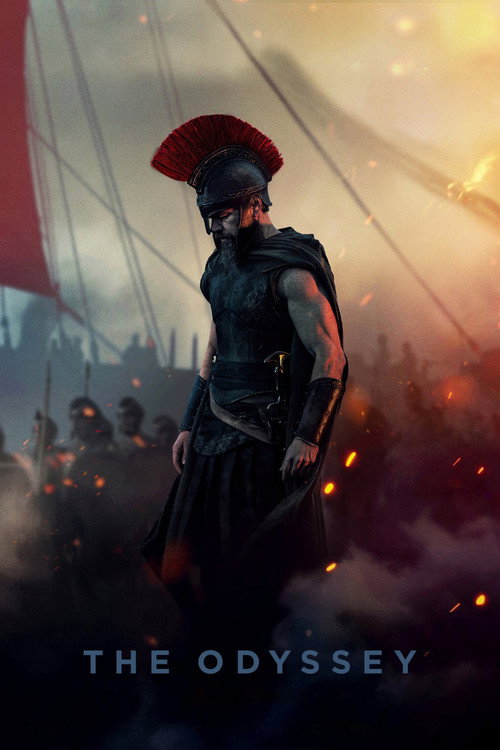
The Odyssey follows Odysseus (Matt Damon), the legendary King of Ithaca, as he struggles to return home after a decade fighting in the Trojan War, only to face another ten years of catastrophic sea voyages before he can reclaim his palace and family. The narrative unfolds across three interlocking movements. At home in Ithaca, a growing mob of suitors occupies Odysseus's palace and pressures his faithful wife Penelope (Anne Hathaway) to accept that her husband is dead and choose one of them as a new husband. Meanwhile, Odysseus's son Telemachus (Tom Holland) comes of age and sets out to discover his father's fate. On the seas, Odysseus endures a gauntlet of divine and monstrous trials: encounters with the Cyclops Polyphemus, the bewitching Circe, the deadly Sirens, and the nymph Calypso (Charlize Theron), who detains him for years. The goddess Athena (Zendaya) serves as Odysseus's divine patron, interceding on his behalf against the opposition of other gods. Odysseus is repeatedly forced to rely on cunning and intellect rather than brute strength to survive. The story also revisits the final stages of the Trojan War, including the Trojan Horse stratagem, depicting the catastrophic consequences of that military deception. The antagonist among the suitors is Antinous (Robert Pattinson), the most aggressive claimant to Penelope's hand. Odysseus finally returns to Ithaca in disguise as a beggar, tests his household's loyalty, and orchestrates the downfall of the suitors — culminating in a bow contest in which only Odysseus can string and shoot his own great bow with precision. He then reveals himself and, with Telemachus and loyal servants, slaughters the suitors. He reunites with Penelope, confirming his identity through intimate knowledge that only the true Odysseus could possess. The film emphasizes themes of homecoming, loyalty, the weight of leadership, the struggle between mortals and gods, and the primacy of wit over force. Note: detailed scene-by-scene plot data is limited as the film had only a London premiere screening as of this writing and has not yet received wide release.
Sources: Wikipedia (premise section), inkandimaginings.com, Letterboxd (early reviews), IMDb (cast/metadata), TMDb overview