Movie
I Love Boosters
Narrative tropes
Rebels vs. The Empire
highThe Velvet Gang — five squatting shoplifters — is a textbook small resistance against a vast power structure: Christie Smith as the imperious fashion mogul and, by escalation, the broader capitalist economic order. All five signals fire: a megacorporation-scale antagonist exploits workers; a small crew organizes against overwhelming odds; the rebels are framed sympathetically as protagonists throughout; Christie is depicted as cruel and corrupt (design theft, 'low-class urban bitches'); and the gang's operations grow into a movement 'threatening to upend the broader economic order,' constituting meaningful resistance achieved despite the power gap.
About this trope: A small outmatched group rises up against a massive oppressive regime or institutional power. The rebellion is framed as morally righteous.
Revenge Is Sweet
mediumPersonal revenge is the explicit inciting motivation: Christie steals Corvette's original design and publicly humiliates the crew, and they respond by planning to 'boost Christie's entire inventory' as direct payback. The wrong done to the protagonist demonstrably drives the plot's launch. Official justice is structurally absent — the crew operates outside the law and has no recourse through institutions. The heist-comedy tone and the film's 'ultimately optimistic outlook' frame the crew's retaliatory action as satisfying rather than troubling. Resolution is unconfirmed (wide release pending), so the cathartic payoff signal is partial, capping count at 3.
About this trope: Vengeance is portrayed as justified, satisfying, and morally righteous. The audience is invited to cheer as the protagonist destroys those who wronged them.
Cultural messages
The Rich Are the Problem
highClass conflict is the film's explicit engine. The crew squats in an abandoned restaurant while Christie commands a luxury fashion empire — sharp visual and narrative contrast between poverty and wealth. Christie exploits and dismisses the working class (stealing Corvette's design, 'low-class urban bitches'); the protagonists are more moral and resourceful by design. The film frames the fashion industry as a system built to benefit the rich at workers' expense (factory and retail workers drawn into the movement). The resolution arc — the heist expanding into anti-capitalist collective action — is exactly 'revolution/exposure of the rich' as payoff.
About this message: Wealthy elites are portrayed as exploitative, callous, or predatory, and extreme inequality is the central injustice driving the story.
Movies that share these tropes



Full plot (spoilers)
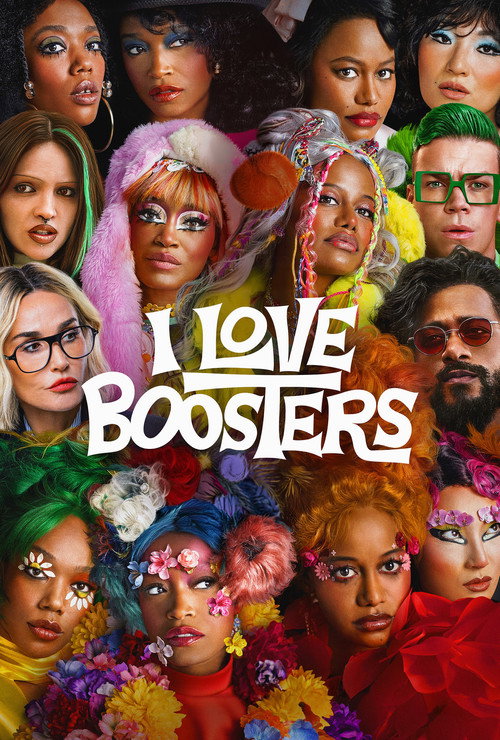
Set in a surreal, heightened version of the San Francisco Bay Area, I Love Boosters follows the Velvet Gang — a crew of professional shoplifters led by Corvette (Keke Palmer), alongside Sade (Naomi Ackie), Mariah (Taylour Paige), Jianhu (Poppy Liu), and Violeta (Eiza González). The women squat in an abandoned chicken restaurant while earning their living by stealing luxury goods and redistributing them at discounted prices throughout the Bay Area. Corvette harbors a secret ambition to become a fashion designer and quietly idolizes Christie Smith (Demi Moore), a powerful, imperious fashion mogul and CEO. When Christie publicly dismisses the crew as 'low-class urban bitches' and steals one of Corvette's original designs, the gang resolves to take direct aim at her: they plan to boost Christie's entire inventory in a sweeping heist. What begins as a targeted act of revenge against one cutthroat fashion maven escalates into something far larger. As the crew's increasingly audacious operations draw in retail and factory workers, the individual heist transforms into a nascent anti-capitalist movement threatening to upend the broader economic order. The film is laced with surreal and psychedelic elements — including claymation body-horror sequences, a teleportation device called a 'situational accelerator' that doubles as a philosophical metaphor, a miniature car chase through a scaled recreation of San Francisco, and a soul-sucking demon — all used to amplify themes of class conflict, racial stereotyping, and systemic exploitation in the fashion industry. The tone blends heist comedy, protest art, and sci-fi absurdism while maintaining an ultimately optimistic outlook on collective resistance. Note: as of the research date, the film had premiered at SXSW (March 12, 2026) but had not yet received wide theatrical release (May 22, 2026); the resolution of the heist and the full ending are not confirmed from available sources.
Sources: Wikipedia, Rotten Tomatoes, Deadline, The Hollywood Reporter, NPR, Letterboxd