Movie
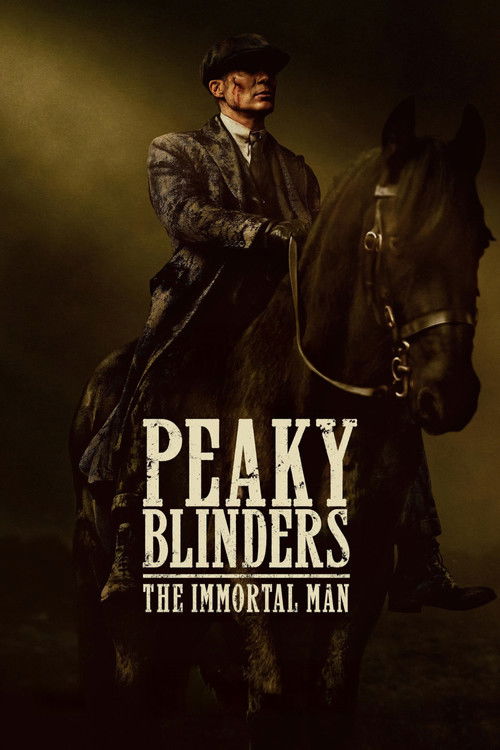
Peaky Blinders: The Immortal Man
Narrative tropes
A Parent's Shadow
highDuke is introduced explicitly as Tommy's illegitimate son who has reconstituted the Peaky Blinders and is repeatedly described as 'more ruthless and sociopathic than Tommy ever was' — he is defined entirely against his father's reputation. Inherited criminality and Tommy's sins (including the secret of Arthur's death) drive the conflict. Duke's arc is a choice between continuing Tommy's violent legacy or forging his own path, resolved when he turns against Beckett and reconciles with his father. The ending frames Duke assuming leadership of the Blinders on his own terms, with Tommy's Gypsy funeral marking the handoff.
About this trope: A character must grapple with the legacy of their parents or predecessors — living up to high standards, running from expectations, atoning for inherited sins, or forging their own path.
Rebels vs. The Empire
highA small criminal gang (the reconstituted Blinders under Tommy and Duke) faces off against a Nazi-backed operation with state-level resources — Beckett is Treasurer of the British Union of Fascists and a Nazi agent commanding mercenary forces. The Blinders are framed sympathetically as the de facto defenders of Britain's wartime economy. The regime is shown as cruel (Beckett kills Ada in cold blood, the counterfeiting scheme exploits concentration camp labor). Victory is achieved: the £70M cache is destroyed and Beckett is killed in a coordinated docks raid despite the obvious power imbalance.
About this trope: A small outmatched group rises up against a massive oppressive regime or institutional power. The rebellion is framed as morally righteous.
Violence Gets Results
highNon-violent institutional channels are demonstrably ineffective: Ada, as a Member of Parliament, possesses evidence against Duke and is murdered for it. No diplomatic or legal mechanism is shown addressing the Nazi counterfeiting plot. The resolution is entirely kinetic — a coordinated paramilitary raid on the Liverpool docks, the destruction of the currency cache by force, and Tommy personally killing Beckett. The story does not frame this violence as troubling or in need of justification; Tommy's death in the raid is treated as heroic sacrifice.
About this trope: The central conflict is ultimately resolved through physical force rather than negotiation, diplomacy, or systemic change. Talking fails; fighting works.
One Hero Changes Everything
mediumA £70M Nazi counterfeiting operation threatening Britain's wartime economy is a crisis that logically demands a governmental response — yet no institution appears to address it. Tommy's return is the singular event that reorganizes the Blinders, undermines Beckett, and makes the Liverpool raid possible. The existing Blinders under Duke were allied with the very threat; without Tommy's intervention the operation would have succeeded. The British government and official channels are entirely absent from the resolution.
About this trope: One exceptional individual matters more than institutions or collective action. Problems affecting millions are solved by a single remarkable person. Everyone else is passive.
Cultural messages
Family Is Everything
highThe entire plot is structured around the fractured Tommy–Duke relationship and its repair. Tommy comes out of exile not to save Britain but specifically to 'save Duke.' Ada's death (the destruction of family) forces both men to commit fully to each other. The emotional climax is Tommy and Duke fighting side by side and then Duke honoring Tommy's dying wish; the resolution is explicitly described as 'estranged father and son finally united.' Duke's Gypsy funeral for Tommy is the story's final image, cementing family loyalty as the operative value.
About this message: Family bonds — biological or found — are ultimately what saves the day, provides meaning, and matters most. Characters who stray from family suffer; those who return are rewarded.
Forgiveness Sets You Free
highMultiple forgiveness arcs run in parallel. Kaulo interprets Tommy's killing of Arthur as a mercy killing and releases him from guilt, enabling his return. Tommy and Duke — estranged by illegitimacy and criminality — reconcile mid-story, which is the pivot that allows Duke to turn against Beckett. Duke's compliance with Tommy's dying request (the mercy shot) is framed as an act of love, not violence. The film's closing description explicitly marks the outcome as 'redemption and reconciliation,' and Tommy's death is peaceful rather than anguished.
About this message: Forgiving — even the unforgivable — is presented as the path to peace and healing. Holding grudges is self-imprisonment; releasing them is liberation.
Power Means Duty
mediumTommy is in self-imposed exile precisely to escape the weight of his capabilities and history. He is pulled back not by ambition but by obligation: Kaulo frames his return as a duty ('convinces him to return to Birmingham to save Duke'), and Ada's warning establishes a societal stakes. His acceptance of the mission costs him his life. The narrative structure — reluctant withdrawal, summons, acceptance, sacrifice — maps the 'power creates duty' arc, with Kaulo functioning as the mentor who makes the obligation explicit.
About this message: Those gifted with extraordinary abilities, wealth, or status have a moral obligation to use them for others — and the weight of that duty can be crushing. Privilege creates obligation.
Movies that share these tropes


Full plot (spoilers)
Set during the Birmingham Blitz in November 1940, the film opens with Nazi Germany executing a scheme to destabilize Britain's wartime economy by flooding it with counterfeit currency manufactured by concentration camp inmates; simultaneously, a Luftwaffe raid destroys a BSA munitions factory. Tommy Shelby (Cillian Murphy) has withdrawn into self-imposed exile following the death of his brother Arthur in 1938, living on a remote country estate and writing his memoirs. His sister Ada, now a Member of Parliament, tracks him down to warn him that the Peaky Blinders gang has been reconstituted under the leadership of his illegitimate son Duke (Barry Keoghan), who is more ruthless and sociopathic than Tommy ever was. Duke has allied himself with John Beckett (Tim Roth), Treasurer of the British Union of Fascists and a Nazi agent, who intends to use the Blinders' criminal networks to distribute approximately £70 million in counterfeit banknotes across Britain. Tommy is then visited by Kaulo Chiriklo, a Gypsy woman who claims to be the twin sister of Zelda Chiriklo — the woman with whom Tommy conceived Duke in 1914. Kaulo claims to have spoken with Arthur's spirit and presses Tommy to reveal the truth of Arthur's death; Tommy admits he accidentally killed Arthur after his brother became dangerously erratic from opium use. Kaulo interprets the act as a mercy killing, entrusts Tommy with a single bullet, and convinces him to return to Birmingham to save Duke. Back in Birmingham, Tommy reconnects with the remnants of his world and begins working to undermine Beckett's operation. When Beckett discovers that Ada possesses evidence of Duke's criminal involvement, he orders Duke to eliminate her. Duke cannot bring himself to carry out the act, but Beckett — having anticipated Duke's hesitation — kills Ada himself. Tommy, devastated by his sister's murder, commits fully to stopping Beckett. Duke, shaken by Ada's death and his own complicity, reconciles with his father and turns against Beckett. In a coordinated raid on the Liverpool docks, Tommy and Duke lead the Blinders in destroying the entire cache of counterfeit currency and overpowering Beckett's mercenary forces. Tommy kills Beckett but sustains a mortal wound in the process. In his final moments, Tommy asks Duke to end his suffering using the bullet Kaulo gave him. Duke complies, and Tommy dies peacefully. Duke assumes leadership of the Peaky Blinders and arranges a traditional Gypsy funeral for his father, whose death is framed as a moment of redemption and reconciliation — the estranged father and son finally united in his final hours. The film also functions as a backdoor pilot for a planned sequel series centered on Duke.
Sources: Wikipedia, IMDb (search/news), general web search synthesis