Movie
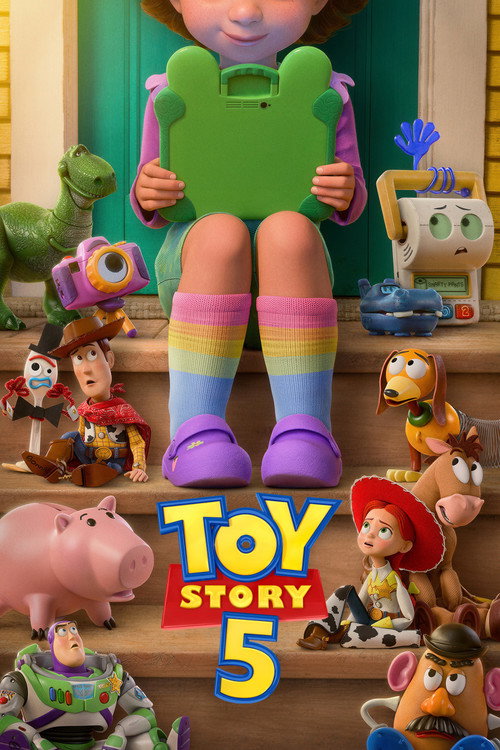
Toy Story 5
Cultural messages
Screens Are Ruining Us
highLilypad is a consumer device that works exactly as designed — connecting Bonnie with peers — yet its normal use is the source of harm. Bonnie 'quickly becomes obsessed with it,' her engagement with toys and imaginative play deteriorates, her peers collectively shift to screens, and The Pond platform actively draws her further from traditional connection. Technology is framed as making classic toys 'nearly obsolete,' hollowing out childhood imagination through ordinary adoption, not malfunction.
About this message: Consumer technology — smartphones, social media, VR, the internet — is portrayed as inherently dehumanizing, addictive, or isolating, even when working as designed. The technology doesn't malfunction; its normal use is the problem.
Family Is Everything
mediumThe toys constitute a found family whose bonds drive the plot. Woody had chosen a new life with Bo Peep but returns when he hears his old friends are in trouble — explicitly choosing family over personal freedom. Jessie and Bullseye's disappearance (separation) throws the group into crisis, and Woody's return to protect them is the emotional engine of the story. Found-family loyalty functions as the moral center against the isolating pull of technology.
About this message: Family bonds — biological or found — are ultimately what saves the day, provides meaning, and matters most. Characters who stray from family suffer; those who return are rewarded.
What Makes Us Human?
mediumThe Multi-Buzz subplot directly stages a question of personhood: ~50–100 replica Buzz figures must reckon with being copies rather than the 'real' Lightyear, forcing a debate about whether identity and authenticity can exist in duplicates. Separately, the film contrasts the toys' emotionally genuine relationships with Lilypad's algorithmically mediated connections, blurring the line between programmed behavior and authentic feeling. The toys throughout demonstrate empathy and moral agency that the humans around them lack.
About this message: As the line between humans and non-humans blurs — AI, clones, aliens, robots — the story forces a reckoning with what truly defines humanity: biology, consciousness, memory, emotion, or moral choice.
The Old Ways Were Better
mediumTraditional toy play is framed as warm and imaginatively rich, while the digital platform represents a colder, less meaningful alternative. The shift toward screens is depicted as loss — classic toys rendered 'nearly obsolete' — and Woody's return to defend the old guard validates the earlier way of playing. The film stops short of making technology purely villainous, but the thematic weight consistently positions pre-screen childhood as the superior mode.
About this message: Traditional, ancestral, rural, or pre-modern life is portrayed as inherently better than modern alternatives. Progress is corruption, not improvement. The past is idealized as a golden age.
Movies that share these tropes



Full plot (spoilers)
Toy Story 5 (2026) is set in Bonnie's bedroom, where the toys face an existential crisis when Bonnie receives a Lilypad — a frog-shaped smart tablet — as a gift and quickly becomes obsessed with it. Jessie, who has taken on the role of Sheriff in Bonnie's room, struggles to keep the toys relevant as Bonnie spends increasing time on the device rather than playing. Bonnie, now about eight years old, is also grappling with the broader cultural shift around her: her peers increasingly prefer screens to toys, and she begins questioning whether she is too old for playtime altogether. The central antagonist is Lilypad itself (voiced by Greta Lee), which represents the digital platform 'The Pond' and helps Bonnie connect with peers through screens, drawing her further from traditional play. When Jessie and Bullseye go missing, Buzz and the rest of the gang are thrown into crisis. Woody, who had left Bonnie's room with Bo Peep at the end of Toy Story 4, hears that his old friends are in trouble and returns to help. A secondary storyline involves a 'Multi-Buzz' plot in which a large number of commemorative Buzz Lightyear action figures — roughly 50 to 100 — are lost following a plane crash and end up causing chaos; these replica figures, voiced by Tim Allen alongside the original Buzz, eventually come to terms with the fact that they are toy copies rather than the real Lightyear. New supporting toys introduced include Smarty Pants (voiced by Conan O'Brien), a toilet-training tech toy forgotten in a shed; Snappy (Shelby Rabara), an excitable toy camera; and Atlas (Craig Robinson), a GPS-equipped talking hippo. Forky (Tony Hale) is also present and reportedly getting married to his utensil companion Karen Beverly. A child character named Blaze (Mykal-Michelle Harris), described as tech-savvy, plays a role in the story. Thematically, the film examines what the shift toward screens means for toys and for children's imagination, positioning technology not as straightforwardly evil but as a force that has made classic toys nearly obsolete. NOTE: This film had not yet been released as of the time of research (release date June 17, 2026); all plot details are drawn from pre-release promotional materials, official Disney/Pixar character guides, and cast interviews rather than from the finished film itself, so some details may differ from the final cut.
Sources: Wikipedia, IMDb, D23 (official Disney), Screen Rant, Toonado (Tim Allen interview), Disney Wiki (Fandom), TMDb overview