Movie
Buddy
Narrative tropes
You Can't Trust Anyone
highBuddy's cheerful host persona is a mask concealing captivity and murder — the children are manipulated into thinking they're participants in a fun show while actually imprisoned. The TV programme itself is the conspiracy: an ostensibly trustworthy institution (children's television) is revealed as a trap. Buddy is the enemy hiding in plain sight, paranoia is fully validated, and the children must reckon with the betrayal of the one figure who seemed to offer safety.
About this trope: Trusted allies, institutions, or authority figures are secretly working against the protagonist. Paranoia is justified because betrayal is real and pervasive.
Rebels vs. The Empire
highBuddy controls every aspect of a looping reality, functions as a totalitarian ruler who responds to dissent with violence, and holds children in perpetual captivity. The children collectively defy him — refusing tasks, fleeing the clubhouse, enduring the perilous journey — and are framed as brave and morally righteous. Freddy's killing of Buddy is the climactic overthrow of an oppressive regime, achieved despite total power asymmetry.
About this trope: A small outmatched group rises up against a massive oppressive regime or institutional power. The rebellion is framed as morally righteous.
Kids See the Truth
highFreddy (a child) possesses a mysterious perceptual connection that allows her alone to break the show's cycle. Grace (an adult) cannot access or navigate Buddy's world effectively and perishes trying. The other children also grasp the truth of their imprisonment before any adult does. A child's clarity — not adult intervention — resolves the supernatural threat, while the adult response (seeking psychological help) proves useless.
About this trope: Children possess intuitive wisdom, moral clarity, or a connection to truth that cynical adults have lost. Kids see through lies, sense danger, and understand what really matters.
One Hero Changes Everything
highAn entire cohort of children is trapped and a traumatised adult (Grace) fails to rescue them from outside. Freddy alone possesses the mysterious connection that enables escape and kills Buddy; all other children die in the process, underscoring that only Freddy's individual ability could resolve the crisis. Institutions (the real world, psychological care) are wholly ineffective, and collective action by the children is insufficient without Freddy's singular intervention.
About this trope: One exceptional individual matters more than institutions or collective action. Problems affecting millions are solved by a single remarkable person. Everyone else is passive.
Humans Never Give Up
mediumChildren trapped in a looping, inescapable world with a murderous captor face objectively hopeless circumstances — escape has been impossible for decades, as the older man's presence confirms. Despite this, they choose active defiance over compliance, risk the perilous journey to Diamond City, and Freddy refuses to surrender until the cycle is broken. Survival and resistance against impossible odds is the story's emotional spine.
About this trope: Facing impossible odds, humans endure, adapt, and find reasons to keep going. Resilience and refusal to surrender is humanity's defining and most admirable trait.
Violence Gets Results
mediumCompliance, passive defiance, and the escape journey all fail to resolve the threat. The plot concludes with Freddy physically killing Buddy as the mechanism that breaks the cycle and ends the captivity. The climax is a direct violent confrontation; non-violent routes (cooperating, fleeing, seeking outside help) do not end Buddy's power.
About this trope: The central conflict is ultimately resolved through physical force rather than negotiation, diplomacy, or systemic change. Talking fails; fighting works.
Movies that share these tropes





Full plot (spoilers)
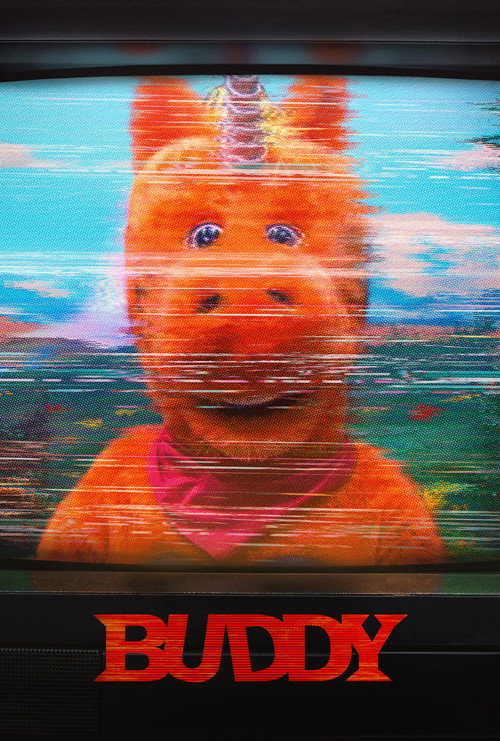
Set in 1999, a group of amnesiac children are trapped inside the surreal, episodic world of 'It's Buddy!', a children's television program hosted by Buddy — a bright orange, humanoid unicorn with a purple heart on his chest who rules from his wacky clubhouse. The children spend their days singing, dancing, and performing tasks to help Buddy spread happiness, seemingly unaware they are prisoners. The show operates in looping episodes: each segment ends with credits that reset the world and restore Buddy from any harm, keeping the children perpetually captive. When one child refuses to participate in the activities, Buddy's cheerful mask slips — he responds not with patience but with violence and murder. His cruelty escalates further when one of the children disappears, prompting the remaining kids to begin defying their captor outright. In retaliation, Buddy forces them on a perilous journey toward the mythical Diamond City. Fleeing the clubhouse into ominous woods, the children discover an older man who was once a participant on the show and has never been able to escape, suggesting the trap has existed for decades. Meanwhile, in the real world, a traumatized suburban mother named Grace is drawn into Buddy's domain while seeking psychological help for her connection to the missing children. A young girl named Freddy emerges as the central protagonist, possessing a mysterious connection to the show's underlying mystery. Freddy ultimately manages to break the cycle, escape Buddy's world, and kill Buddy — but at a devastating cost: Grace and all the other children perish in the process.
Sources: Wikipedia, Web search (aggregated pre-release and review sources), Flickering Myth review