Movie
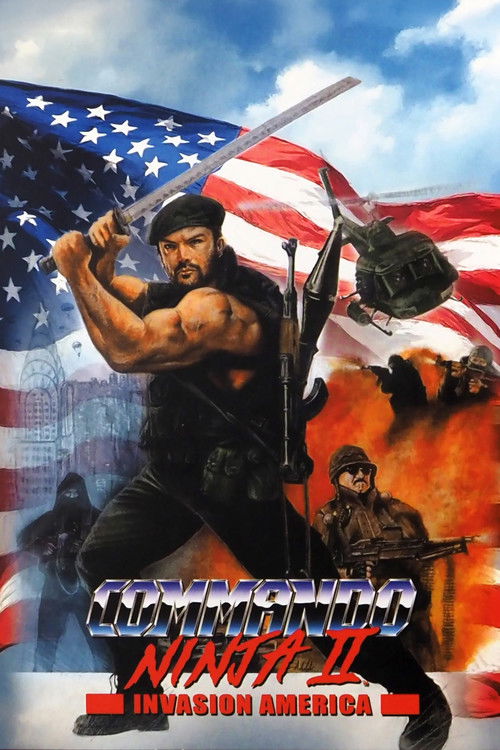
Commando Ninja 2: Invasion America
Narrative tropes
Rebels vs. The Empire
highFour-person team faces entire hidden Soviet invasion force (divisions beneath cities, sewer networks, sleeper agents) — maximal power imbalance. The team is framed as heroic American defenders. The regime is shown as cruel and deceptive. Victory is achieved when the small team pushes back the invasion all the way to Vietnam. All five signals fire: totalitarian force, small band, morally righteous rebels, dehumanizing regime, victory against odds.
About this trope: A small outmatched group rises up against a massive oppressive regime or institutional power. The rebellion is framed as morally righteous.
Violence Gets Results
highHopkins immediately discards conventional government channels as useless — the only viable path is armed combat. The team fights through waves of troops, travels to Vietnam, and kills their way to the source. The climax is a violent confrontation, the heroes' defining skills are combat (Vietnam vet, cybernetic soldier), and the campy parody frame never questions whether violence was appropriate. All five signals present.
About this trope: The central conflict is ultimately resolved through physical force rather than negotiation, diplomacy, or systemic change. Talking fails; fighting works.
You Can't Trust Anyone
highSleeper agents embedded within the civilian population are the mechanism of the Soviet operation — the enemy hides in plain sight among trusted citizens. The conspiracy is concealed at institutional scale (divisions hidden beneath cities). Hopkins discovers he cannot use official channels, implying government is compromised or infiltrated. Paranoia is fully validated. Four signals: sleeper-agent traitors, compromised institution, protagonist must question civilians, true enemy hiding among allies.
About this trope: Trusted allies, institutions, or authority figures are secretly working against the protagonist. Paranoia is justified because betrayal is real and pervasive.
One Hero Changes Everything
highA full-scale military invasion of the United States — logically requiring a national military response — is resolved by a four-person team led by Hopkins. Government institutions are explicitly useless. No army, no coordinated response; a single protagonist's initiative is the decisive factor. Four signals: lone team defeats what armies cannot, institutions incompetent, hero's skill is decisive, collective action absent.
About this trope: One exceptional individual matters more than institutions or collective action. Problems affecting millions are solved by a single remarkable person. Everyone else is passive.
Man-Made Monsters
mediumUS military toxic agents deployed in Vietnam decades earlier are the unintended origin of the bloodthirsty mutants the heroes face. The creator (US military) crossed a natural boundary and the creation now has lethal autonomy its creators cannot control. Core pattern met: identifiable creator, transgression of natural limits, creation turns destructive. Two signals: creator identifiable (US military), creation has autonomous destructive power beyond creator's control.
About this trope: A creator uses science to overstep natural boundaries — creating life, resurrecting the dead, engineering organisms, or fundamentally altering nature — and the creation turns destructive.
Cultural messages
The Military Are Heroes
highThe hero team is composed of a military officer (Hopkins), a Vietnam veteran (Hunter), and a near-cybernetic soldier (Kowalsky). They are unambiguously heroic, the enemies (Communist invaders) are clearly evil, and military-style combat is what saves the day. Even as parody, the film celebrates rather than critiques this framing. Four signals: military characters in lead roles, depicted as unambiguously heroic, military force solves what civilians cannot, enemies justify the use of force.
About this message: The military, intelligence agencies, or law enforcement are portrayed as fundamentally noble, heroic, and necessary. Service members are brave and selfless. Military force is justified and effective.
The System Is Rigged
mediumHopkins determines 'conventional government channels are useless' and immediately goes rogue, assembling his own team. Sleeper agents embedded in the civilian population imply the government cannot distinguish friend from enemy. True resolution comes entirely outside institutional authority. Three signals: working within the system fails, cover-up/conspiracy operates within official channels, justice only comes from operating outside institutional rules.
About this message: Institutions meant to protect people — governments, corporations, law enforcement, the justice system — are depicted as corrupt, incompetent, or actively harmful. Heroes must work outside official channels.
Movies that share these tropes


Full plot (spoilers)
Set in 1988, Soviet-backed Communist forces have spent ten years secretly preparing an invasion of the United States — hiding entire military divisions beneath major cities, moving troops through the sewer network, and embedding sleeper agents within the civilian population. On the 4th of July, the day chosen to trigger the operation, officer Hopkins uncovers the conspiracy and realizes conventional government channels are useless. He assembles a small team: Vietnam veteran John Hunter, the hulking Kowalsky (who has become a near-cybernetic, Terminator-like soldier), and Jenny. Together they fight their way through waves of Communist troops attacking American cities. As the team pushes back the invasion, they trace the operation to its source — Vietnam, called 'the house of the rising sun.' The mission escalates into outright absurdity as the heroes travel to Vietnam and confront not only enemy soldiers but also dinosaurs and bloodthirsty mutants, the latter being the unintended product of US-military toxic agents deployed decades earlier. The film is a deliberate, campy parody of 1980s action cinema — referencing Red Dawn-style invasion plots, Terminator-style cyborgs, and B-movie creature features — with over-the-top gore and deliberately ridiculous set-pieces throughout.
Sources: IMDb, Letterboxd, TMDb, Web search aggregation